Swing Trading Strategy Guide: How to Capture Big Market Moves with Less Screen Time | .ONE% Capitals
Swing Trading · Strategy Guide · Worldwide
Swing Trading Strategy: Capture Big Market Moves with Just 30–60 Minutes a Day
You don't need to watch charts all day to make money trading. Swing trading lets working professionals, business owners and anyone with limited screen time capture the most powerful multi-day moves in forex, stocks and commodities — using the same institutional framework that powers .ONE% funded traders worldwide.
Keshav Dargar
May 10, 2026
22 min read
Global Guide
30–60 Min Daily System
30–60
Minutes Per Day Required
1–7
Day Trade Hold Time
1:3+
Avg Risk-Reward Ratio
$4M
The5ers Scale Target
The myth that trading requires staring at charts for 8 hours a day is one of the most damaging misconceptions in the industry. It drives people toward scalping and intraday strategies that demand constant screen time — when for many people, swing trading is both more suitable and, done correctly, more consistently profitable.
Swing trading captures the multi-day price moves that technical and fundamental forces build over time. A single well-executed swing trade targets 80 to 300+ pips in forex, 3 to 10% in stocks, or 50 to 200+ points in commodities. These moves play out over days — meaning you set your trade in the evening, manage it briefly the following morning, and let the market do the work in between.
This guide is the complete .ONE% swing trading framework — the setups, the entry and exit system, the risk rules for multi-day positions, and the prop firm path for swing traders who want to scale without deploying personal capital.
Swing Trading — Capturing Multi-Day Price Swings in Forex, Stocks and Commodities
What Is Swing Trading? The Core Definition
Swing trading is the practice of holding a trading position for between one day and several weeks — long enough to capture a significant portion of a directional price move (a "swing") while exiting before the move exhausts itself. Swing traders work primarily on the Daily and H4 timeframes for setup identification, dropping to H1 or H4 for entry precision.
The fundamental premise of swing trading is that markets do not move in straight lines. Price zigzags — trending in a direction, then pulling back, then resuming. A swing trader's job is to identify the direction of the larger move, wait for a high-probability pullback or consolidation, enter in the direction of the trend, and hold through the next leg of the swing to the target.
The Swing Structure
Markets alternate between impulse moves (trending direction) and corrective moves (counter-trend pullbacks). Swing traders enter at the end of corrections to ride the next impulse leg.
Time in Market
Typical hold time: 1 to 7 days. Some setups on the Daily timeframe extend to 2 to 4 weeks. The goal is to be in the market only when price is actively moving in your direction.
Target Size
Forex: 80–300+ pips per trade. Gold: 200–800 points. Stocks: 3–10% per swing. These larger targets justify holding through short-term noise and market hours outside your timezone.
Who It Suits
Working professionals, business owners, parents, students — anyone with 30 to 60 focused minutes per day but not continuous intraday screen time. Swing trading is built for real life.
"Swing trading isn't less work than day trading. It's different work — fewer decisions, but each decision must be of much higher quality."
Swing Trading vs Day Trading vs Scalping: The Honest Comparison
No trading style is objectively superior. The right choice depends on your lifestyle, available time, personality under pressure, and the instruments you want to trade. Here is the direct comparison.
Scalping
Seconds to Minutes
Screen time required 6–8 hrs/day
Trades per day 20–50+
Target per trade 5–15 pips
Avg R:R ratio 1:1 or lower
Prop firm compatible Often restricted
Overnight risk None
Stress level Very high
Feedback speed Very fast
Day Trading
Minutes to Hours
Screen time required 2–4 hrs/day
Trades per day 1–5
Target per trade 20–80 pips
Avg R:R ratio 1:2 to 1:3
Prop firm compatible Excellent
Overnight risk None
Stress level Moderate
Feedback speed Fast
Swing Trading
1 to 7 Days
Screen time required 30–60 min/day
Trades per day 0.5–2 per week
Target per trade 80–300+ pips
Avg R:R ratio 1:3 to 1:5+
Prop firm compatible Excellent (The5ers)
Overnight risk Yes — managed
Stress level Low to moderate
Feedback speed Slower (days)
The Critical Trade-Off to Understand
Swing trading's lower trade frequency means slower feedback loops. A scalper generates 200+ data points per week to improve their system. A swing trader generates 5 to 10. This is not a weakness — it means each trade decision must be better-researched and the system must be more robustly back-tested before going live. Quality over frequency.
The Best Markets and Instruments for Swing Trading
Not all instruments swing equally well. The best swing trading markets share common characteristics: clear trending behaviour on the Daily and H4 timeframes, sufficient overnight liquidity, and fundamentals that create multi-day directional biases. Here are the instruments covered in the .ONE% swing trading curriculum.
EUR/USD
Forex Major
The world's most traded pair. Clean multi-day trends driven by ECB and Fed divergence. Tight spreads reduce overnight holding costs.
Best for Beginners
GBP/USD
Forex Major
Higher volatility than EUR/USD means larger swing targets (120–400 pips) but wider stop requirements. Powerful when the Bank of England drives trend.
High Volatility
Gold (XAU/USD)
Commodity
The premier swing trading instrument. Gold trends powerfully on macro themes (risk-off, USD weakness, inflation). Daily timeframe setups consistently deliver 300–800+ point moves.
Strongest Trends
Nasdaq / US30
Index
US equity indices swing powerfully around macro data events. Strong weekly and monthly ranges provide high-probability swing setups. Traded via CFDs in most prop firms.
High Range
Nifty 50 / BankNifty
Indian Market
India's benchmark indices provide excellent swing setups on the Daily chart, driven by RBI policy, FII flows and global risk sentiment. Covered in the .ONE% Indian market curriculum.
India Specific
Oil (WTI/Brent)
Commodity
OPEC decisions and geopolitical events create powerful multi-week oil trends. Strong swing setups on Daily timeframe. Higher overnight swap costs require careful position sizing.
Macro-Driven
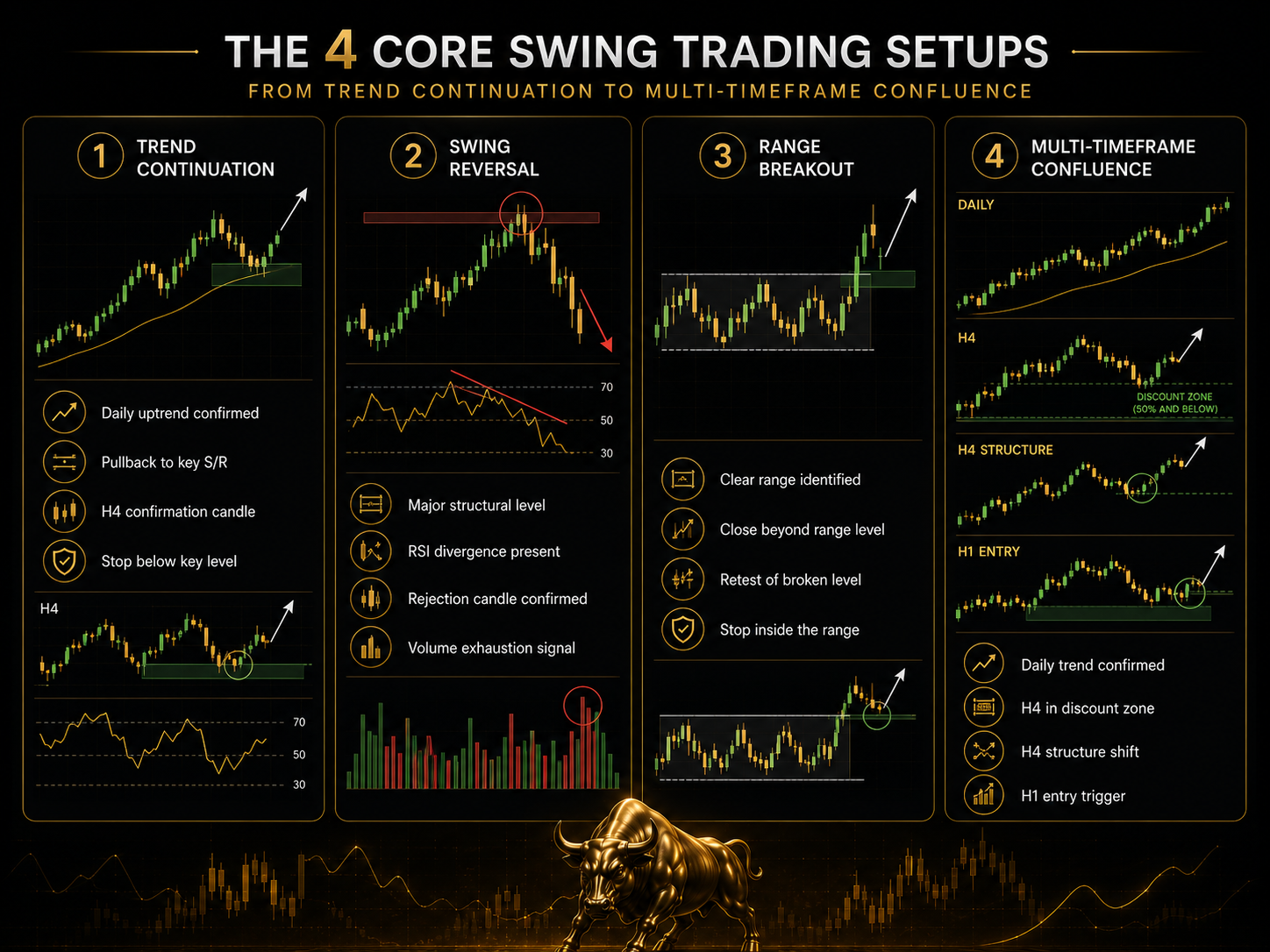
The 4 Highest-Probability Swing Trading Setups
Every swing trade in the .ONE% framework requires at least three confluence factors from higher timeframe analysis. These are the four core setup types that provide those confluences most consistently. Learn all four — but master one before adding the next.
Trend Continuation
Pullback to Key Level in a Trending Market
The highest-probability swing setup. When price is in a clear Daily uptrend (higher highs, higher lows), wait for a pullback to a key support level — a previous swing high now acting as support, a major moving average, or a 50–61.8% Fibonacci retracement zone. Enter when lower timeframe (H1 or H4) shows bullish reversal confirmation: a bullish engulfing candle, pin bar or break of structure. Target: the previous swing high and beyond.
When price reaches a major historical resistance or support level — a multi-week high, a key round number, or a long-term trendline — and shows exhaustion signals. Look for bearish divergence on RSI, a large rejection candle (shooting star, bearish engulfing), and reduced momentum on the final push. Enter short on the confirmation candle close. Target: the last major swing low. Higher R:R but lower win rate than trend continuation — use smaller initial size.
Major structural levelRSI divergence presentRejection candle confirmedVolume exhaustion signal
Range Breakout
Consolidation Breakout with Volume Confirmation
When price has been consolidating in a defined range for 5 to 20+ candles on the Daily chart, a breakout above resistance (or below support) with increasing momentum signals the start of a new swing. Wait for a close above the range high — not just a wick — then enter on the retest of the broken level as new support. This retest entry provides significantly better R:R than entering directly on the breakout candle.
Clear range identifiedClose beyond range levelRetest of broken levelStop inside the range
Multi-Timeframe Confluence
Daily and H4 Alignment at Premium or Discount Zones
The most institutionally-aligned swing setup. Identify a Daily bullish trend. On H4, identify price retracing into a discount zone (below the 50% of the most recent Daily range). Wait for H4 to show bullish market structure shift — the H4 makes a higher high for the first time in the pullback. Enter long at the next H4 pullback or consolidation breakout. The multiple timeframe alignment creates the highest confluence and the most reliable setups in the entire swing trading system.
Daily trend confirmedH4 in discount zoneH4 structure shiftH1 entry trigger
The 4 Core Swing Trading Setups — From Trend Continuation to Multi-Timeframe Confluence
The Complete Swing Trade Entry and Exit System
Every swing trade must have its entry, stop-loss and take-profit defined before the position is opened. The .ONE% entry and exit system eliminates guesswork and removes decision-making from emotional in-market states.
Entry: Wait for the Close — Never Chase
Enter on the close of the confirmation candle — not during it. A bullish engulfing candle on H4 is only confirmed when the candle closes. Entering mid-candle based on the current position exposes you to last-minute reversals that invalidate the signal. Use limit orders where possible — set your entry price at the confirmation level and let the market come to you rather than entering at market on the next candle open.
Stop-Loss: At the Technical Invalidation Point
For a pullback-to-support long, the stop goes below the support level where the trade setup becomes invalid — typically 5 to 15 pips below the key level for cushion against wicks. For a breakout retest, the stop goes back inside the old range. Never place a stop based on a pip number you can afford — place it where the trade thesis is mathematically wrong. If this stop placement requires too large a position to stay within 1% risk, reduce the lot size, not the stop distance.
Take-Profit: The Partial Exit Strategy
The .ONE% swing exit system uses two take-profit levels. TP1 at 1:1 risk-reward — close 50% of the position and move stop-loss to break-even. TP2 at 1:3 to 1:5 risk-reward — the previous major swing high (for longs) or swing low (for shorts). This approach locks in profit at TP1 regardless of outcome, while leaving the remaining position open to capture the full swing move. Never move your stop-loss back against the trade once it has been moved to break-even.
Trailing Stop: Locking In Profit as the Trade Runs
Once TP1 is hit and stop is at break-even, use the most recent Higher Low (for longs) on the H4 timeframe as your trailing stop. As price makes new highs and forms new higher lows, move your stop to below each new higher low. This keeps you in the trade for the full duration of the swing while systematically protecting accumulated profit. Exit when a higher low is broken — the swing structure has changed.
Risk Management for Overnight and Multi-Day Positions
Swing trading introduces risks that intraday trading does not face: overnight gaps (price opening significantly higher or lower than where it closed), weekend risk (2 days of news and events accumulating while no trading occurs), and swap costs (daily interest charges on held positions). Managing these is not complicated — it requires slightly different rules than pure intraday trading.
Risk Factor
The Risk
The .ONE% Rule
Position Size
Standard 1% risk per trade still applies
Calculate based on stop distance — never change this
Overnight Gap Risk
Price can gap beyond stop-loss overnight
Reduce size to 0.5% on volatile instruments ahead of major data
Weekend Risk
48 hours of news with no ability to exit
Close 50% position into weekend if not at TP1 yet
Swap Costs
Daily interest charged on held positions
Factor swap into TP calculation — only hold if TP > swap cost
News Events
High-impact news can spike beyond stop
Reduce size 50% or move stop to break-even before NFP/rate decisions
Correlation Risk
Multiple pairs moving in same direction
Max 2 correlated positions open simultaneously — aggregate risk ≤ 2%
Daily Loss Limit
Multiple open positions could all hit stop
Total portfolio risk never exceeds 3% of account simultaneously
The Weekend Risk Trap
Holding a full-size position into the weekend without protection is the most common swing trading mistake. Geopolitical events, central bank statements and economic releases over 48 hours can gap prices far beyond your stop-loss on Monday open. The rule: if a trade has not reached TP1 before Friday close, either close 50% of the position or move the stop-loss significantly closer to current price. Protecting capital is always more important than capturing the maximum profit.
Swing Trading with Prop Firms: Which Ones Work Best
Not all prop firms are equally suited to swing trading. The key variables are overnight holding rules, weekend holding rules, and news trading restrictions. Here is the definitive breakdown for swing traders.
The5ers — Best for Swing Traders
Allows overnight holding, weekend holding and news trading on all plans. The scaling plan from $5K to $4M is ideal for swing traders building long-term funded careers. .ONE% recommends The5ers as the primary prop firm for swing strategy students.
Blueberry Funded — Good Option
Plan-dependent rules — the Pro plan allows overnight holding. Lower Phase 1 target (8%) makes it more accessible for swing traders who may take fewer but larger trades. Good for building first funded account confidence.
FTMO — Check the Plan Rules
FTMO restricts overnight positions and news trading on some account types. The Swing account option allows overnight and weekend holding — specifically designed for swing traders. Verify current rules before choosing FTMO for a swing strategy.
.ONE% Onyx & Vantage
Onyx and Vantage students receive free funded accounts ($10K and $50K) — avoiding evaluation fees entirely. Both programs include swing trading strategy modules. The Vantage $50K account is the fastest path to meaningful swing trading income.
Prop Firm Compatibility for Swing Traders — Which Firms Allow Overnight and Weekend Holding
Your Swing Trading Daily Routine: The 30–60 Minutes That Actually Matter
The power of swing trading is that it fits around a normal life. Here is the exact daily time allocation used by .ONE% swing trading students — working professionals across India, UAE, UK and globally who trade funded accounts around their primary career.
Morning Session (15–20 minutes)
Review overnight price action on Daily chart — did any setups trigger or invalidate?
Check economic calendar for today's high-impact events and tomorrow's data
Review any open positions — assess whether trailing stop needs updating
Identify any new Daily or H4 setups that formed overnight — mark levels
Set limit orders or price alerts for potential new entries during London open
Note current account P&L, max drawdown used, and trading plan for the day
Evening Session (15–30 minutes)
Review the Daily candle close — how did price behave relative to your analysis?
Update H4 analysis — have new setups formed? Have existing ones been confirmed?
Check tomorrow's economic calendar — any red-impact events that affect open positions?
Set entry orders for any new setups identified during the evening analysis
Weekend only: decide which positions (if any) to carry over with adjusted sizing
The Discipline of Doing Nothing
On most days as a swing trader, the correct action is no action. Checking your positions and charts, confirming your analysis still holds, and closing the platform is a complete and successful trading day. The trap swing traders fall into is manufacturing reasons to enter new trades on no-signal days — typically out of boredom or FOMO. A day with no trades is not a wasted day. It is a disciplined one.
The .ONE% Swing Trading Framework — Mentorship Programs
Swing trading is taught explicitly across the .ONE% Apex, Onyx and Vantage tiers — including the multi-timeframe analysis framework, the four core setup types, the entry and exit system, risk management for overnight positions, and the prop firm path specific to swing strategies. Students in the Onyx and Vantage tiers receive funded accounts where the swing system can be deployed immediately upon completion of mentorship.
.ONE% Mentorship Programs — Start Swing Trading the Right Way
.ONE% Swing Trading Students — Building Funded Trading Careers Around Normal Working Lives Worldwide
Trade Less. Earn More. Swing Smarter.
Your Career Doesn't Have to Stop. Your Trading Can Start.
Swing trading is the strategy that works around a full professional life — not instead of one. Join the .ONE% mentorship used by working professionals across India, UAE, UK and globally to build funded trading income in 30–60 minutes a day. Book your free strategy call today.
Swing trading is a trading style that holds positions for 1 to 7 days (sometimes longer) to capture multi-day price swings. Swing traders work primarily on the Daily and H4 timeframes, targeting 80 to 300+ pip moves in forex or 3 to 10% moves in stocks, checking charts 1 to 2 times per day rather than monitoring the market continuously throughout the session.
Neither is objectively better — the right choice depends on your lifestyle and available time. Swing trading suits working professionals who cannot monitor charts throughout the day, offering 30–60 minutes of daily analysis with positions running automatically between sessions. Day trading suits those who can dedicate 2–4 focused hours per session. Swing trading typically offers higher R:R potential per trade, while day trading provides faster feedback for skill development.
Effective swing trading requires approximately 30 to 60 minutes per day — split between a morning review (15–20 minutes to check overnight price action and update open positions) and an evening analysis session (15–30 minutes to identify new setups and set orders for the next session). This is the primary reason swing trading is the preferred strategy for working professionals, business owners and anyone with a structured daily schedule.
Gold (XAU/USD) is widely considered the best swing trading instrument due to its powerful multi-day trends driven by macro themes. EUR/USD and GBP/USD are the best forex pairs for swing trading. The Nasdaq and US30 indices offer excellent swing setups around macro data events. For Indian traders, Nifty 50 and Bank Nifty on the Daily timeframe provide consistent swing setups driven by FII flows and RBI policy decisions.
Yes. The5ers is the most swing-trader-friendly major prop firm, allowing overnight holding, weekend holding and news trading on all plans, with a scaling plan from $5,000 to $4,000,000. FTMO offers a Swing account option specifically for traders who need overnight and weekend holding allowances. .ONE% recommends The5ers as the primary prop firm target for students using swing strategies. Onyx and Vantage students receive free funded accounts ($10K and $50K) to deploy their swing strategies immediately.
The biggest risk in swing trading is overnight and weekend gaps — when price opens significantly beyond your stop-loss level due to news or events that occurred while you were not trading. The mitigation rules are: never exceed 1% account risk per trade, reduce position size to 0.5% before major news events, close 50% of any position that has not reached TP1 before the weekend, and set hard stop-loss orders (not mental stops) on every position before closing the platform.
.ONE% covers swing trading across the Apex (60 days), Onyx (75 days) and Vantage (90 days) programs. The swing trading curriculum includes: multi-timeframe analysis for bias and setup identification, the four core setup types, the .ONE% entry/exit system including the partial profit strategy, overnight and weekend risk management rules, and The5ers prop firm evaluation coaching specific to swing strategies. Book a free strategy call at calendly.com/pointone0/30min to discuss the right program.
Keshav and Khushal teach institutional swing and intraday trading frameworks to students worldwide through the .ONE% mentorship ecosystem. Verified funded accounts on FTMO, The5ers and Blueberry. Serving traders across India, UAE, UK, Singapore and globally. India: +91 91166 52754 · UAE: +971 54 450 4401 · onepercent862@gmail.com · Book Free Call