

Forex trading attracts millions of new participants every year — drawn by the promise of a market that never closes, that anyone with an internet connection can access, and that has made genuine fortunes for those who approached it correctly. It has also taken significant amounts of money from those who approached it without a framework.
This guide is the framework. It is the foundation of what we teach at .ONE% Capitals — the same starting point for every student from the Cartel (entry level) to the Vantage (premium elite) tier. By the time you finish reading it, you will understand the market mechanics, the analysis tools, the strategies, and the risk rules that determine whether forex trading becomes a profitable skill or an expensive education in what not to do.

What Is Forex Trading and How Does It Work?
Forex — short for foreign exchange — is the global marketplace where currencies are bought and sold against one another. When you exchange pounds for dollars before travelling to the United States, you participate in the forex market. When a corporation converts euro revenues back to yen, that is forex. When a hedge fund takes a position that the US dollar will weaken against the Japanese yen, that is forex trading.
The forex market is the largest and most liquid financial market in the world, with over $7.5 trillion in daily turnover. It operates 24 hours a day, five days a week, across four major trading sessions: Sydney, Tokyo, London, and New York. Unlike stock exchanges, there is no central exchange — forex is an over-the-counter (OTC) market, meaning trades are conducted directly between participants through a global network of banks, brokers, and electronic platforms.
"The forex market doesn't pay you for being smart. It pays you for being consistent. Discipline is the one edge that never stops working."
Currency Pairs, Pips, Lots and Leverage Explained
Before placing any trade, you need to understand the four core mechanics that define every position in the forex market. These are not advanced concepts — they are the building blocks that determine your risk on every single trade.
The Major Currency Pairs — Start Here
The 4 Core Mechanics You Must Master
-
Pip — The Unit of MeasurementA pip (percentage in point) is the smallest standard price movement in a currency pair. For most pairs, one pip is 0.0001. If EUR/USD moves from 1.0850 to 1.0860, that is a 10-pip movement. Profits and losses are calculated in pips multiplied by position size. Understanding pips is the foundation of all risk calculation.
-
Lot Size — How Much You Are TradingA standard lot is 100,000 units of the base currency. A mini lot is 10,000 units. A micro lot is 1,000 units. For a standard lot on EUR/USD, each pip is worth approximately $10. For a micro lot, each pip is worth approximately $0.10. Choosing the correct lot size for your account size and risk tolerance is the most important calculation before every trade.
-
Leverage — Amplification in Both DirectionsLeverage allows traders to control a position larger than their account balance. A 1:100 leverage ratio means a $1,000 account can control a $100,000 position. Leverage amplifies both profits and losses equally. The institutional approach is to use leverage as a convenience tool — not as a risk amplifier. Maximum 1% account risk per trade is the rule that makes leverage safe to use.
-
Spread — The Cost of Every TradeThe spread is the difference between the bid price (what the broker pays you when you sell) and the ask price (what the broker charges when you buy). On EUR/USD with a major broker, this is typically 0.1 to 0.3 pips. The spread is your transaction cost — it is why scalpers prioritise tight-spread brokers, and why high-frequency trading on wide-spread pairs is self-defeating for retail traders.
The Best Forex Trading Sessions and Times
The forex market is open 24 hours, but it is not equally active across all 24 hours. Liquidity, volatility, and setup quality vary dramatically by session. Trading in the wrong sessions is one of the most common beginner mistakes — sitting in front of charts during the Asian session midday, when nothing meaningful is happening, then missing the London open where the real price action occurs.
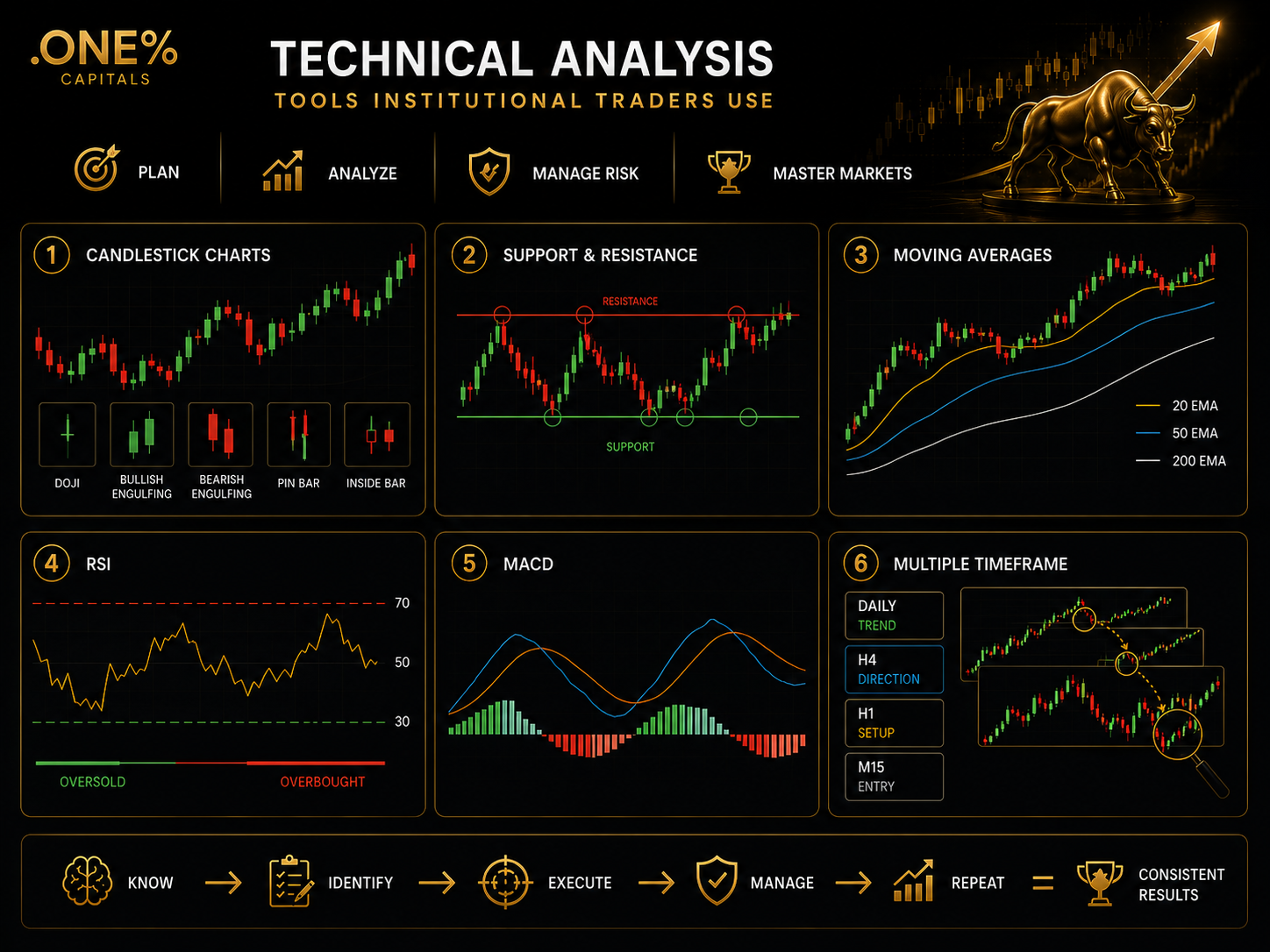
Technical Analysis: Reading Charts Like a Professional
Technical analysis is the study of price action through charts — identifying patterns, levels and signals that indicate where price is likely to move next, based on the historical behaviour of market participants. It is the primary tool used in all four trading strategies and the foundation of the .ONE% technical mastery module.
Fundamental Analysis: What Actually Moves Currency Pairs
While technical analysis tells you where price might move based on chart structure, fundamental analysis tells you why it moves — and why it might move further or reverse entirely. Understanding both is what separates comprehensive traders from chart-only analysts who get caught off-guard by news events.
| Economic Indicator | Currency Impact | Release Frequency | Why It Matters |
|---|---|---|---|
| Interest Rate Decisions | Highest Impact | Every 6–8 weeks | Higher rates attract capital inflows, strengthening the currency. The single most important fundamental driver. |
| Non-Farm Payrolls (NFP) | Very High Impact | First Friday monthly | US employment data moves USD pairs dramatically. Avoid trading the 30 minutes before and after release. |
| CPI (Inflation Data) | Very High Impact | Monthly | Higher inflation typically leads to rate hike expectations, strengthening the currency in the short term. |
| GDP Growth | High Impact | Quarterly | Strong GDP growth signals economic health, supporting the currency over medium timeframes. |
| Central Bank Statements | Highest Impact | As scheduled | Tone and language of central bank communication moves currency markets regardless of rate decisions. |
| PMI Data | Medium Impact | Monthly | Purchasing Managers Index above 50 = expansion. Below 50 = contraction. Leading indicator of economic direction. |
The 4 Forex Trading Strategies: Which One Is Right for You?
There is no universally best forex trading strategy — there is only the strategy that matches your lifestyle, personality, and available time. All four styles are taught across the .ONE% curriculum. Here is an honest breakdown of each.
Dozens of small trades per session targeting 5–15 pip moves. Requires constant screen time, ultra-tight spreads, fast execution and deep pattern recognition. The highest-frequency strategy — and the most psychologically demanding.
- Multiple daily income opportunities
- Short exposure time per trade reduces overnight risk
- Requires hours of uninterrupted screen time
- Transaction costs compound rapidly at high frequency
- Not compatible with most prop firm evaluation rules
Open and close all positions within a single trading session. Targets 20–80 pip moves, typically 1–3 trades per day. The primary strategy taught in .ONE% programs and the most compatible with prop firm evaluation rules — no overnight risk, clear daily targets, structured session-based routine.
- Fully compatible with FTMO and prop firm evaluations
- Clear daily session boundaries support psychological discipline
- No overnight gap risk — all positions closed daily
- Works in 2–4 focused hours per day
- Misses longer-term multi-day trend moves
Captures multi-day price swings — typically 80–300 pip moves. Lower trade frequency (2–5 per week) allows more flexible working hours. Excellent for full-time professionals who cannot watch charts intraday. Fully compatible with The5ers and many prop firm models that allow overnight holding.
- Works for people with a day job or other commitments
- Higher R:R potential per trade than day trading
- Best with The5ers (allows weekend holding)
- Overnight and weekend gap risk
- Fewer trades means longer feedback loops for improvement
Macro-driven, long-term trades held for weeks or months capturing 500–2000+ pip moves. Driven primarily by fundamental analysis — interest rate divergence, economic cycle positioning, geopolitical shifts. Very low trade frequency. Requires deep fundamental knowledge and strong psychological hold through significant drawdown periods.
- Minimal daily time requirement once trade is placed
- Massive potential R:R ratios on major trend trades
- Very slow feedback loop — months between significant results
- Not suitable for prop firm evaluations (time constraints)
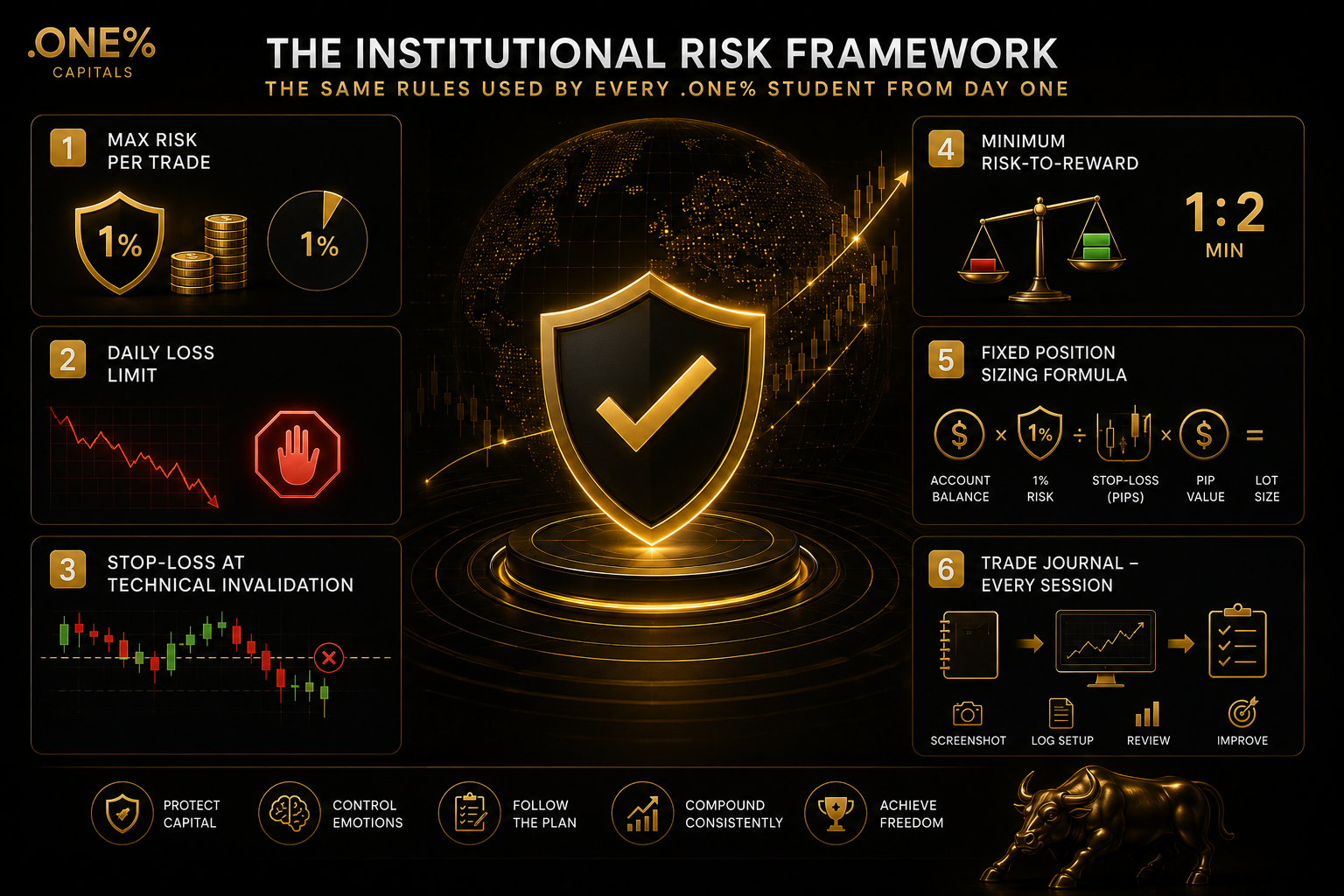
Institutional Risk Management: The Rules That Actually Determine Profitability
Risk management is not a section to skim. It is the entire foundation of profitable trading. The overwhelming majority of retail traders who lose money do not lose because they have bad strategies — they lose because they have catastrophic risk management. A 60% win rate strategy with poor risk management loses money. A 40% win rate strategy with excellent risk management makes money.
Here are the exact risk rules taught at .ONE% — derived from how institutional trading desks at major banks and prop firms operate:
Essential Forex Glossary — Terms Every Trader Must Know
Your First 30 Days: The Right Way to Start Forex Trading
The most important decision a new trader makes is not which broker to use or which strategy to follow. It is the decision to spend meaningful time in preparation before deploying any real capital. The traders who skip this phase spend 12 to 24 months learning the same lessons in the most expensive way possible.
- Days 1–7: Foundation and Platform SetupStudy market structure, currency pairs, pips, lots and leverage until these are second nature. Download MT4 or MT5, open a demo account with a regulated broker, and familiarise yourself completely with the platform before looking at a single trade setup. The goal of this week is to remove all mechanical friction so your mental bandwidth is available for analysis, not platform operation.
- Days 8–14: Technical Analysis and Chart ReadingSpend this week exclusively on reading charts. Practice identifying support and resistance, trend structure, candlestick patterns, and moving average positions on historical data. Mark levels on multiple timeframes and check your analysis the next day to see how price responded. Do not place any trades — only observe and document.
- Days 15–21: Strategy Selection and Back-TestingChoose one strategy — intraday or swing, based on your available time. Back-test it manually on 3 months of historical data across at least two currency pairs. Document every hypothetical entry: the setup, the risk-reward, the outcome. You need at least 50 back-tested trades to get a statistically meaningful read on whether the strategy has a positive edge.
- Days 22–30+: Demo Trading Under Live ConditionsBegin demo trading the strategy in real market conditions — but with exact institutional risk rules from day one: 1% max risk per trade, 2% daily stop, 0.5–1% daily target. Journal every session. Do not move to live capital until you have completed 30 profitable demo sessions with consistent rule adherence. The demo phase is where the habit architecture gets built.
The Funded Account Career Path — Where Forex Trading Becomes a Profession
Once you have a tested strategy and consistent demo performance, the prop firm model transforms forex trading from a personal speculative activity into a professional career. Rather than growing a small personal account slowly over years, you prove your skill in an evaluation and receive access to institutional capital immediately.
The three major prop firms that .ONE% Capitals has verified funded accounts with — FTMO, The5ers and Blueberry — all accept traders from 150+ countries. All three refund the evaluation fee on the first profit split. All three offer scaling plans that grow your allocation over time.
- Market DNA — Complete Foundation
- Technical & Fundamental Analysis
- 1 Proven Trading Strategy
- Risk Management Module
- Live Trading Sessions
- Lifetime Trading Assistance
- Full Core Curriculum
- 2 Advanced Strategies
- FTMO Evaluation Coaching
- Funded Account Pass Guidance
- Psychology & Execution Training
- Multi-Commodity Trading
- 4 Institutional Strategies
- Personal 1:1 Mentor Sessions
- Live Trading With Mentors
- FREE $10,000 Funded Account
- 1 Month Community Access
- 5 Elite Institutional Strategies
- Institutional Discipline Intensive
- Personal 1:1 Sessions
- FREE $50,000 Funded Account
- 3 Month Community Access

Your Preparation Should Be Too.
Most forex traders spend 12 to 24 months making avoidable mistakes. A structured mentorship compresses that to 40 to 90 days — with live feedback, proven strategies, and an institutional framework that has already produced funded traders worldwide. Book your free strategy call today.