

Every trader starts the same way. They study charts, learn patterns, back-test a strategy, and feel prepared. Then they go live. Within weeks — sometimes days — the account is bleeding. The strategy that worked perfectly in theory performs erratically in practice. Not because the strategy is wrong. Because the person executing it has changed under the pressure of real money.
This is the psychology problem. It is the most written-about subject in trading and simultaneously the most ignored in practice. Knowing you are emotionally trading and being able to stop it are two entirely different skills — and most traders never develop the second one.
This guide is the complete .ONE% psychology framework. It is not motivational. It is not theoretical. It is the systematic, habit-based approach that produces disciplined traders who pass prop firm evaluations, manage funded accounts, and build genuine trading careers — from London to Lagos, from Mumbai to Melbourne.
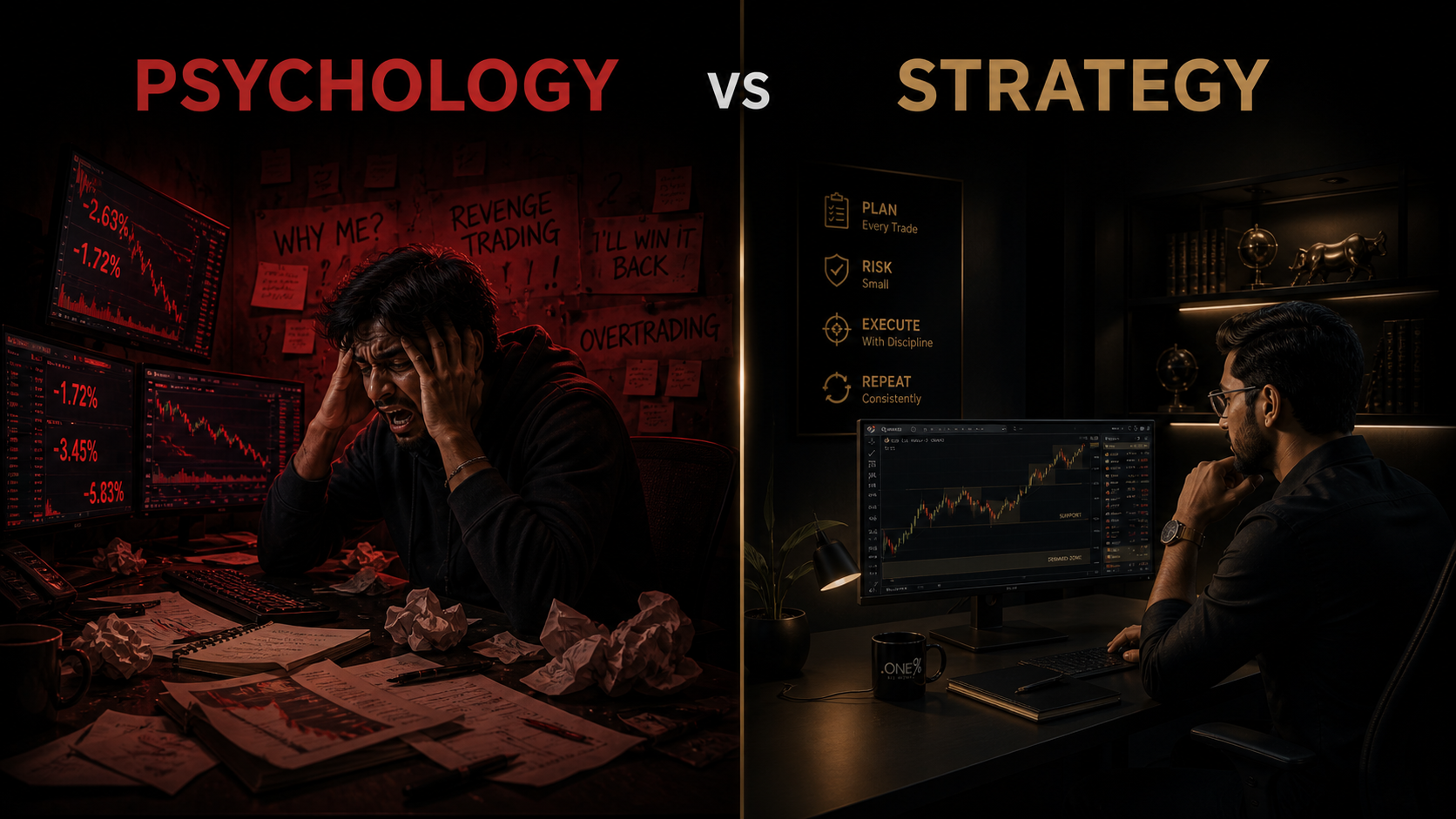
The Real Reason 95% of Traders Fail
Multiple studies across different markets and timeframes converge on the same finding: between 70% and 95% of retail traders lose money consistently. The common explanation is that trading is simply too complex. That markets are too random. That retail traders cannot compete with institutions.
This explanation is convenient but incorrect. The real finding — when you dig into the actual behaviour of losing traders — is that most of them have a workable strategy. Their analysis is often sound. Their setups, in isolation, are frequently correct. They lose because they cannot execute their own rules under emotional pressure.
The three specific psychological failure modes that account for the majority of retail trading losses are: revenge trading (placing additional trades after a loss to recover immediately), FOMO entries (entering valid-looking setups that are already overextended), and position sizing escalation (unconsciously or consciously increasing size after a winning streak, then taking an oversized loss that wipes out the gains).
"Your strategy is not your edge. Your ability to execute your strategy consistently — across 200 trades, in winning streaks and losing streaks alike — that is your edge."
The Neuroscience Behind Emotional Trading
Understanding why emotional trading happens at a biological level is not academic — it is practical. When you understand what is happening in your brain during a losing trade, you can build systems to counteract it rather than willpower against it.
The critical insight here is this: you cannot willpower your way out of these biological responses. No amount of determination overrides a cortisol-flooded brain in the moment of a losing trade. The institutional solution is not to become emotionless — it is to build systems that make most decisions before the emotional state can interfere with them.
The 7 Emotional Patterns That Destroy Trading Accounts
These are the seven predictable, identifiable emotional patterns that the .ONE% framework specifically trains against. Most traders can identify themselves in at least four of them.
Placing one or more trades immediately after a loss specifically to recover the lost capital. Position sizes are typically larger than the standard rule. The emotional driver is the need to "undo" the loss rather than to find a valid trading opportunity. This is the single most common cause of blown accounts and failed prop firm evaluations globally.
Fatal — Account Killer #1Entering a trade that is already 50–80% completed because of fear that the remaining move will be missed. FOMO entries almost universally result in poor risk-reward ratios — the stop-loss is wide (the move has already run) and the take-profit is close. A missed trade costs nothing. A FOMO entry often costs significantly.
Fatal — Systematic R:R DestructionMoving a stop-loss further away from the entry when price moves against the position, in order to avoid realising the loss. This converts a manageable risk into an uncontrolled one. The trader convinces themselves that the trade "just needs more room" — but the original stop-loss position was placed at a technical invalidation point for a reason.
Fatal — Turns 2% Losses Into 8%Closing a profitable trade before it reaches the planned take-profit level out of fear that the profit will disappear. This systematically degrades the risk-reward ratio of the strategy over time. A strategy designed for 1:2 R:R becomes 1:0.7 R:R when profit is taken early. The statistical edge is eliminated.
Critical — Destroys Strategy Edge Over TimeTaking more trades than the strategy calls for — typically after a losing streak (to recover) or a winning streak (due to overconfidence). Quality setups appear one to three times per day in most liquid markets. Forcing additional trades beyond this generates entries in noise rather than signal, with systematically worse outcomes.
Critical — Dilutes Strategy QualityUnconsciously or consciously increasing position size after a series of wins ("I'm on a hot streak") or after a loss ("I need to recover faster"). This is the mechanism by which traders who are profitable across 15 trades give back all the gains on trade 16. Institutional traders use fixed formula-based sizing that never changes based on recent performance.
Critical — Single Trade Wipes Multi-Week GainsThe inability to execute a valid setup because of excessive second-guessing, often driven by recent losses. The trader has identified a genuine A+ setup meeting all entry criteria, but fear of another loss prevents execution. This is the opposite of overtrading — but equally damaging to long-term performance, as it selectively removes winning trades from the outcome distribution.
Significant — Removes Winning Trades From the Sample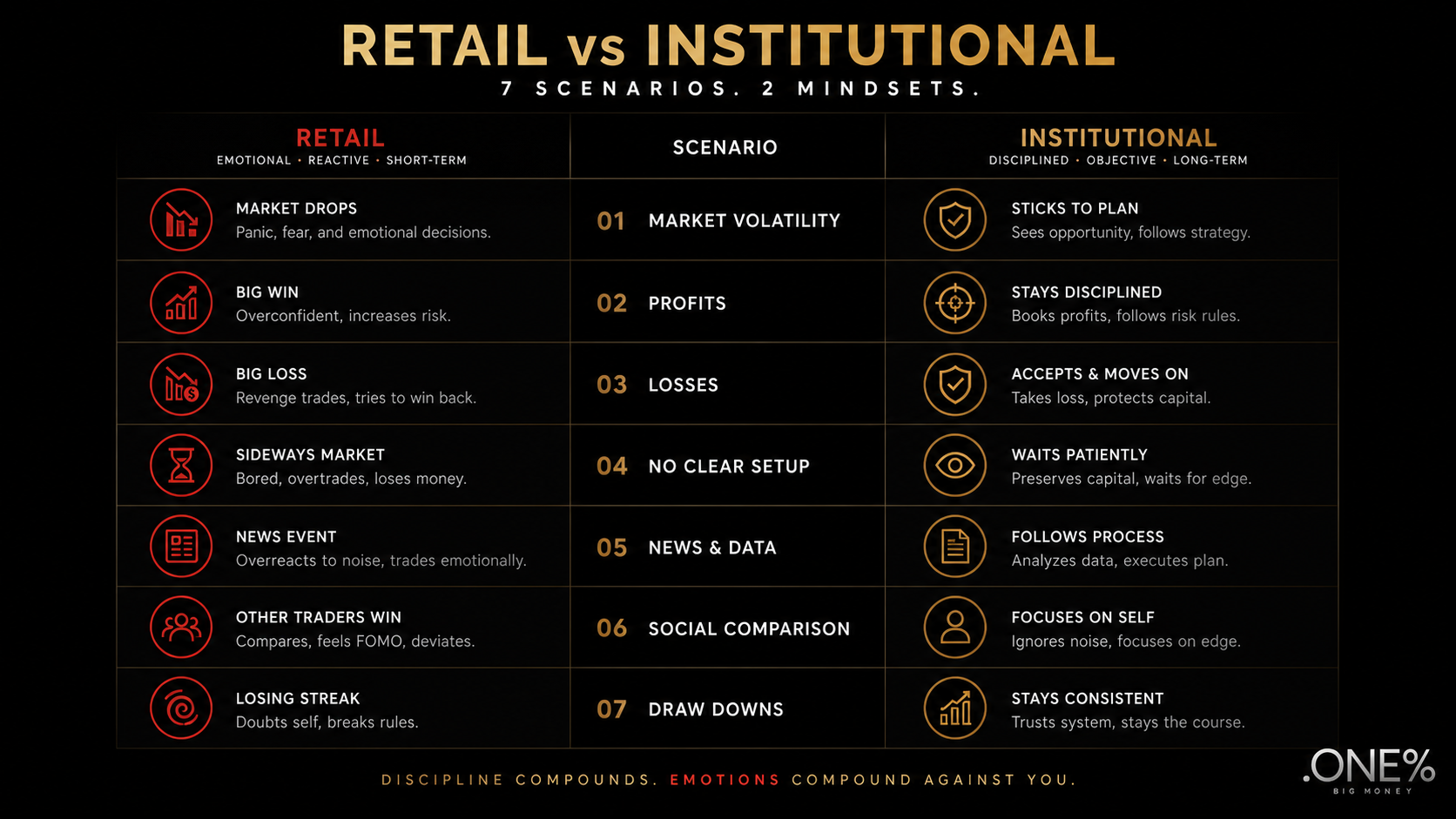
Retail Brain vs Institutional Brain: The Core Difference
The difference between a retail trader and an institutional desk trader is not intelligence, access to information, or technical skill. It is the relationship with individual trade outcomes.
| Situation | Retail Trader Response | Institutional Response |
|---|---|---|
| Losing trade hits stop-loss | Frustration — revenge or over-analysis | Expected outcome — part of the distribution |
| 3 consecutive losses | Questions the strategy, increases size | Reviews journal, maintains fixed size |
| Missing a large winning move | FOMO — chases entry or forces next trade | Logs the missed setup, waits for next signal |
| Account up 5% in one week | Increases risk, feels invincible | Maintains risk parameters, reviews why it worked |
| News event creates volatility | Trades the excitement, often over-sizes | Reduces size or stands aside until clarity returns |
| Winning trade reaches TP1 | Closes fully out of fear of giving back | Takes partial at TP1, trails stop to TP2 |
| Bad trading day (down 2%) | Continues trading to "make it back" | Closes platform. Day is done. No exceptions. |
The pattern is consistent across every row. The institutional response is not more emotionally sophisticated — it is more pre-programmed. Institutional traders operate within a rulebook that was written in a calm, objective state before the trading session began. Their decisions are made in advance. The execution is almost mechanical.
Retail traders make almost every decision in real-time, inside an emotionally activated state. This is the structural problem — and it is entirely fixable through systematic habit-building rather than willpower.
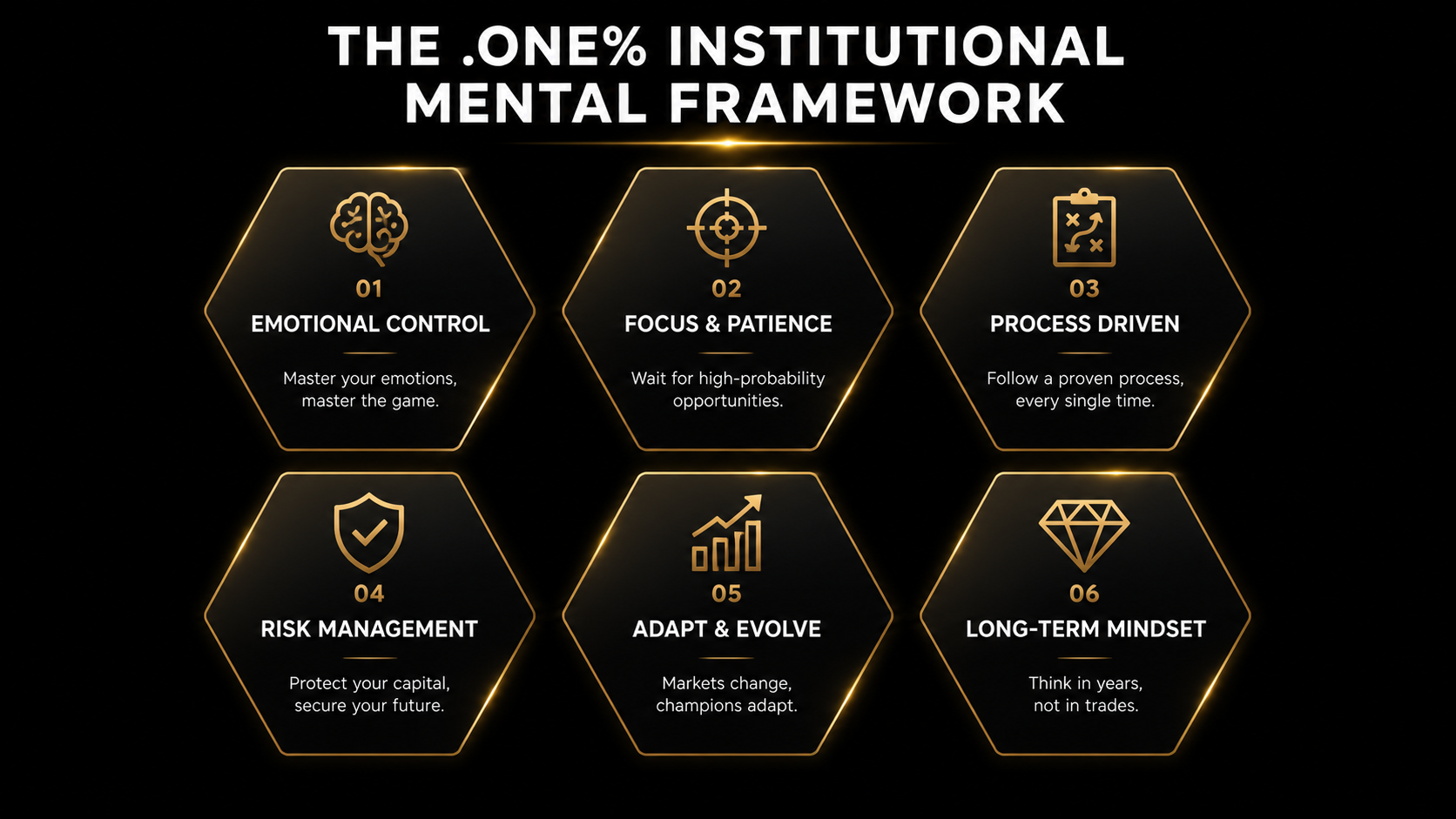
The .ONE% Institutional Mental Framework
The .ONE% psychology framework is not a collection of motivational principles. It is a set of concrete, enforceable rules and habits that systematically remove emotional decision-making from the trading process. Every student at every tier learns and implements this framework before trading live capital.
The Daily Routine That Eliminates 80% of Emotional Decisions
The professional trader's day is structured. Not loosely structured — rigorously structured. The routine does not exist to make trading feel professional. It exists to push the maximum number of decisions into a calm, pre-session state where cortisol and adrenaline are not present. Here is the exact daily structure taught in the .ONE% curriculum.
-
0130–60 Minutes Before SessionHigher Timeframe Bias Analysis
Review H4 and Daily charts. Identify the structural bias — is price in a premium or discount zone? Is there a clear directional trend or are we in range? Mark the decision: bullish, bearish, or neutral. Do not open positions before this is complete.
-
0220–30 Minutes Before SessionKey Level Identification
Mark every relevant level on H1 and H4: support and resistance, liquidity pools above and below current price, any unfilled imbalances. These levels define where you will look for entries and where you will absolutely not trade.
-
0310 Minutes Before SessionDefine Today's Rules in Writing
Write down — physically or digitally — the day's parameters: maximum risk per trade, maximum trades per session, daily stop-loss threshold, and the specific setup criteria required before entry. This is not optional. Writing it creates accountability.
-
04During SessionExecute Only What Was Pre-Planned
Trade the plan. If a setup does not meet the pre-written criteria, it does not get entered. If a new narrative develops mid-session, do not react to it live — log it, review it after session, and incorporate it into tomorrow's pre-session analysis.
-
05Immediately After SessionTrade Journal and Rule Adherence Review
Before closing the platform, document every trade taken: the setup, the entry trigger, whether you followed the pre-session plan, and the outcome. Ask one question: did I follow the rules today? The answer matters more than the P&L.
-
06Weekly — SundayPerformance Review and Pattern Identification
Review the entire week's journal. Identify patterns in your mistakes: are you breaking rules at specific times? After specific market conditions? At specific P&L levels? This is where genuine self-awareness is built — not from individual trades but from the pattern across a full week.
How to Build a Trader's Journal That Actually Works
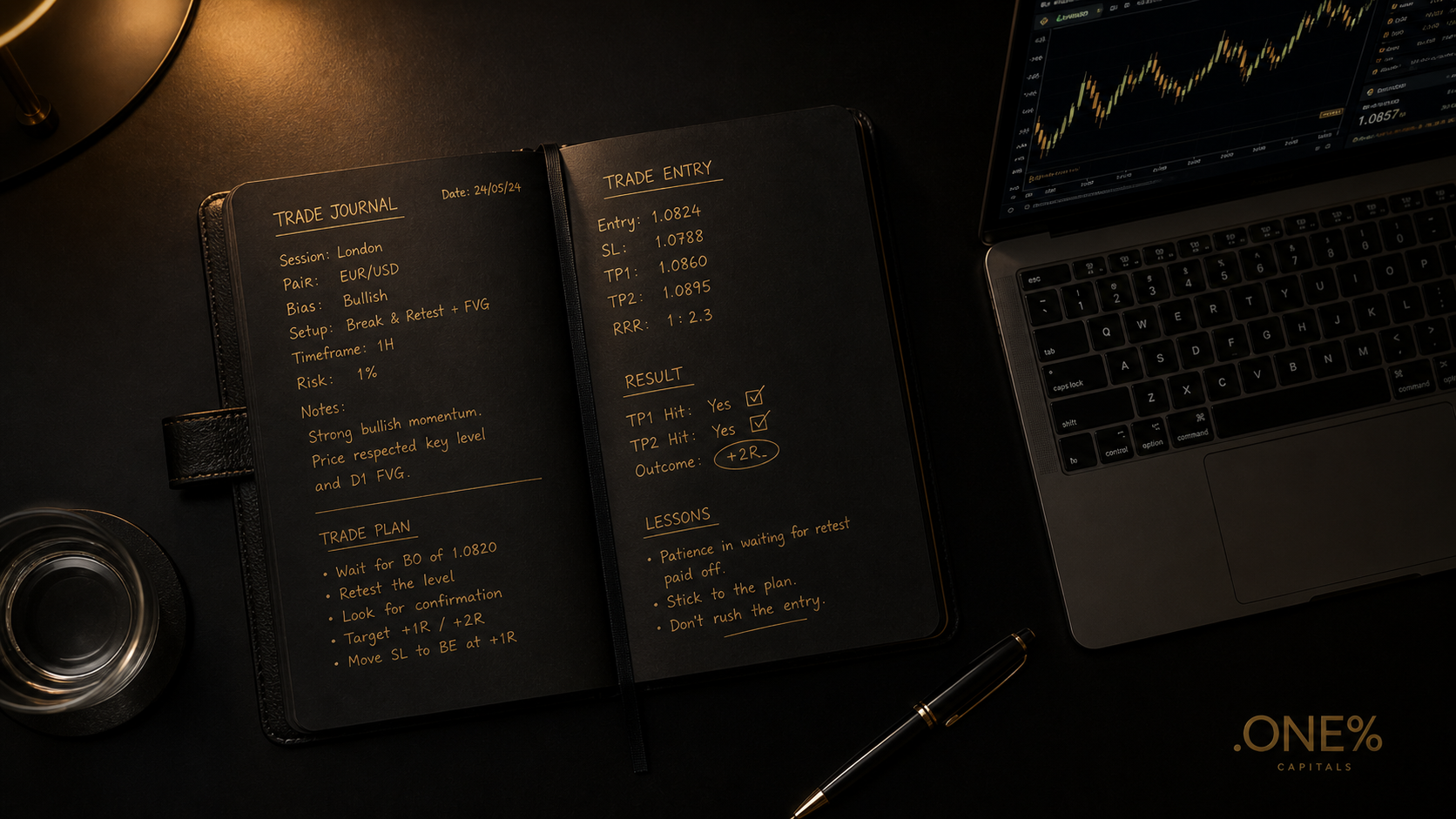
Most trading journals fail because they track outcomes rather than behaviour. A journal that records "won £240 today" tells you almost nothing useful. A journal that records the quality of each decision — regardless of outcome — is where real development happens.
- Record the Setup Before Entry, Not AfterBefore entering any trade, screenshot the chart and write one sentence: "I am entering long because [HTF bias], [key level reaction], [LTF confirmation pattern]." If you cannot complete that sentence before entry, you do not enter. Recording the setup before entry prevents post-trade rationalisation — the tendency to see a reason for the trade only after knowing the outcome.
- Grade Rule Adherence Out of 10, Not P&LAfter each trade, give yourself a rule adherence score from 1 to 10: Did you follow the entry criteria? Did you place the stop-loss at the correct technical level? Did you manage the position according to the plan? A trade can be a 10/10 in process and a losing trade simultaneously — and it should be recorded as a success.
- Track the Emotion at Entry and ExitAdd a one-word emotion tag to each trade entry: "confident," "rushed," "FOMO," "hesitant," "calm." Over time, you will build a clear picture of which emotional state produces your best and worst trades. Most traders discover their worst entries are correlated with specific identifiable states — and that awareness alone begins to change behaviour.
- Weekly Pattern Review — Look for the Recurring MistakeAt the end of every week, scan the journal for the recurring mistake. Not all mistakes — the one mistake that appeared most often. Address only that one mistake in the coming week. Attempting to fix all psychological issues simultaneously is ineffective. Systematically eliminating them one by one, week by week, produces consistent improvement.
The .ONE% Psychology Module — What We Teach and Why It Produces Funded Traders
Every .ONE% mentorship tier — from Cartel (40 days) to Vantage (90 days) — includes a dedicated Psychology and Discipline module. This is not a single lecture. It is an ongoing, integrated component of the entire mentorship that runs parallel to technical and strategic training.
The reason we invest so heavily in psychology before allowing students to trade live capital is simple: technically brilliant traders fail prop challenges that disciplined beginners pass. We have seen this directly. A student who applies average strategy with exceptional discipline will outperform a talented analyst who cannot control size and frequency under pressure.
- Market DNA + Core Curriculum
- Psychology & Discipline Module
- Live Trading Sessions
- Lifetime Trading Assistance
- Multiple Asset Mastery
- Full Psychology Module
- 2 Advanced Strategies
- Prop Firm Evaluation Coaching
- Funded Account Pass Guidance
- Execution Under Pressure Training
- 4 Institutional Strategies
- Personal 1:1 Mentor Sessions
- Live Trading With Mentors
- FREE $10,000 Funded Account
- 1 Month Community Access
- 5 Elite Strategies
- Institutional Discipline Intensive
- Personal 1:1 Sessions
- FREE $50,000 Funded Account
- 3 Month Community Access
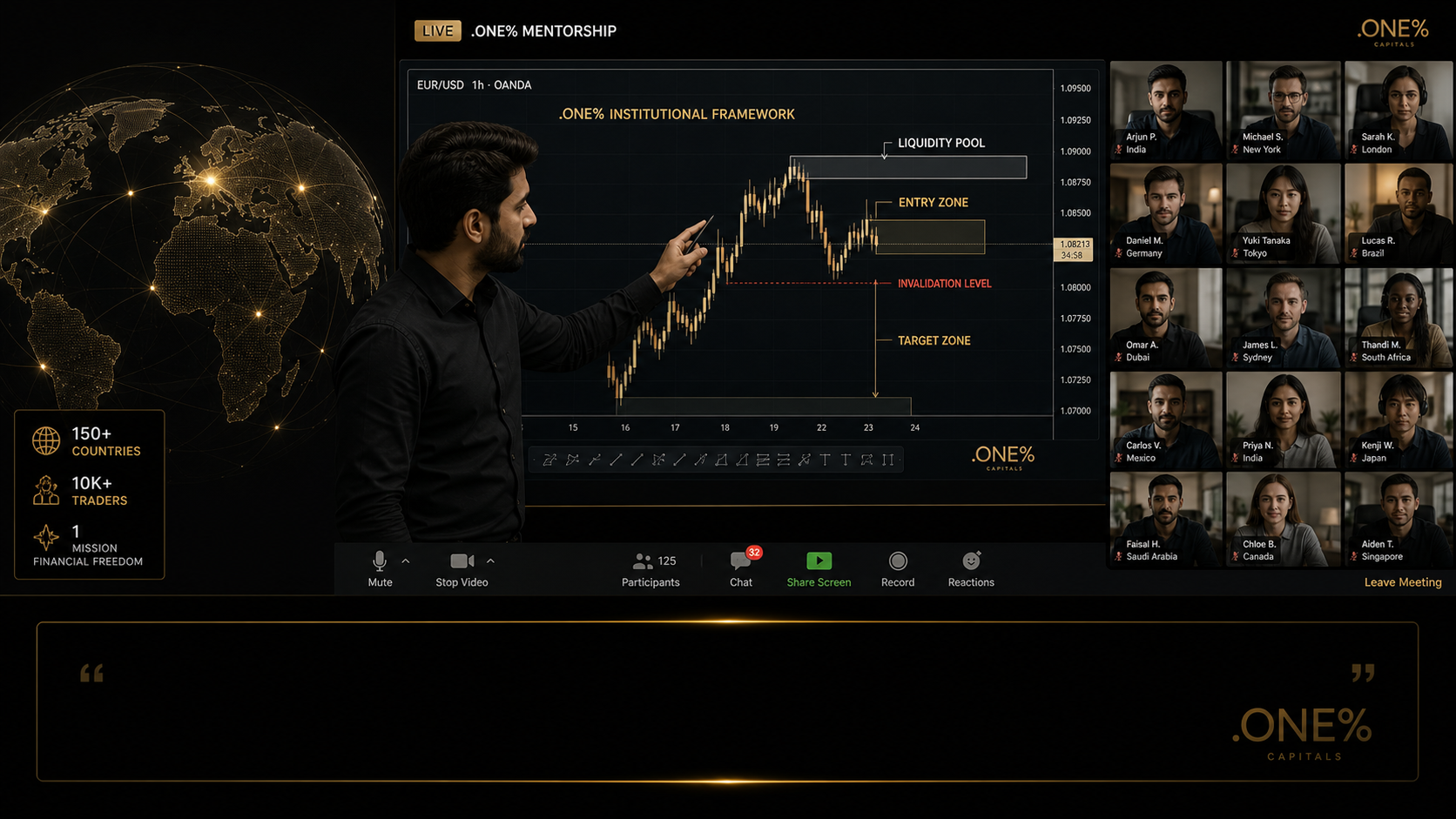
Build the Mindset That Executes It.
Join the .ONE% mentorship used by funded traders across India, UAE, UK, Singapore and beyond. Structured psychology training integrated with live market execution — from day one. Book your free strategy call with a founder today.
onepercent862@gmail.com · +91 91166 52754 · +971 54 450 4401 · Book Free Strategy Call