Day Trading for Beginners: The Complete Guide to Intraday Trading | .ONE% Capitals
Day Trading  ·  Intraday Guide  ·  Worldwide

Day Trading for Beginners: The Complete Intraday Trading Guide

Day trading is the most accessible path to professional trading — 2 to 4 focused hours per session, no overnight risk, and the highest-probability setups in the market available twice every trading day. This is the complete institutional framework for doing it correctly from the very first session.

Keshav Dargar
May 18, 2026
22 min read
Worldwide Guide
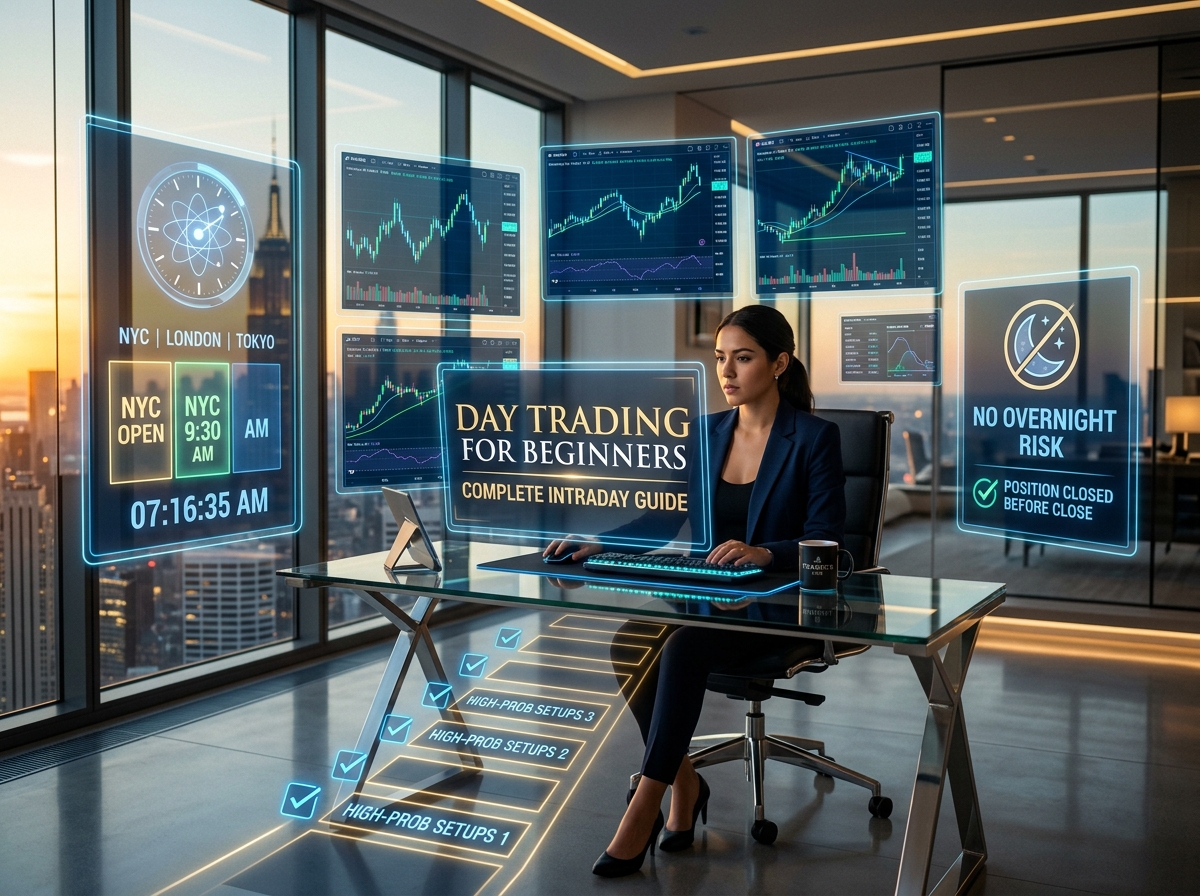
Day trading for beginners — complete intraday trading guide — .ONE% Capitals worldwide
2–4 Hour Sessions
2–4
Hours Per Session
1–3
Trades Per Day
1:2+
Minimum R:R Target
0×
Overnight Risk

The appeal of day trading is straightforward: you trade during a defined session window, close all positions before the session ends, and go about the rest of your day with no open positions and no overnight risk. The day is clean. The result is known. You either made money or you didn't — and you begin the analysis of why.

The reality of day trading is equally straightforward: it is the most psychologically demanding trading style because every decision happens in real time, under live market conditions, with real capital at stake. The difference between a profitable day trader and a perpetually losing one is not strategy — it is the presence or absence of a systematic execution framework that removes emotion from critical decisions.

This guide is the complete .ONE% intraday framework — the sessions, the setups, the rules, the mistakes, and the prop firm path that allows skilled day traders to access institutional capital and trade it for a living, from anywhere in the world.

Professional day trading intraday session setup — two monitors forex charts — .ONE% Capitals worldwide
Day Trading — Opening and Closing All Positions Within a Single 2–4 Hour Session Window

What Is Day Trading? The Core Definition and How It Works

Day trading (also called intraday trading) is the practice of opening and closing all trading positions within a single trading session — typically within 2 to 4 hours. A day trader does not hold positions overnight. All trades are opened and closed within the same session window, with the account returning to a flat (no open positions) state at session end.

Day traders profit from intraday price movements — the 20 to 80+ pip moves that occur when institutional order flow enters the market during the highest-liquidity session windows. These moves are predictable in structure, if not in timing, because they are driven by the same institutional behaviour patterns that repeat session after session across weeks, months and years of market history.

No Overnight Risk
All positions closed before session end. No gap risk. No overnight news events affecting open trades. Your account resets clean every single day — one of day trading's most powerful structural advantages.
Defined Session Windows
Day trading is session-specific. You trade the London open, the New York open, or both. Outside these windows, the chart is closed. Discipline is built into the structure of the trading day itself.
Fast Feedback Loop
Unlike swing trading (days per trade) or position trading (weeks), day trading provides 1–3 trades worth of feedback per session. This accelerates skill development and pattern recognition significantly faster.
Daily Repeatability
The same session patterns repeat daily. The London open liquidity grab, the New York open expansion, the session midpoint consolidation — these structures are predictable and learnable over time.

"A day trader doesn't need to predict where the market is going tomorrow. They only need to understand what institutions are doing in the next two hours — and that is a very learnable skill."

The Two Best Day Trading Sessions in the World

Professional day traders do not trade all day. They trade specific session windows — typically 90 to 180 minutes — where institutional order flow is highest, spread costs are lowest, and price action is cleanest. Here are the two windows that produce the majority of high-quality intraday setups across all instruments.

London Open
8:00 AM – 10:30 AM GMT
IST: 1:30 PM – 4:00 PM  ·  GST (UAE): 12:00 PM – 2:30 PM  ·  EST: 3:00 AM – 5:30 AM  ·  SGT: 4:00 PM – 6:30 PM

The London open is the most important moment of the forex trading day. The world's largest financial centre comes online and institutional order flow enters the market, sweeping out liquidity from the Asian session range and setting the directional bias for the day. The first 90 minutes of London produce more tradeable setups than any other equivalent window in the 24-hour cycle. This is the primary session for .ONE% day trading students globally.

EUR/USD GBP/USD XAU/USD EUR/GBP GBP/JPY
New York Open
1:00 PM – 3:30 PM GMT
IST: 6:30 PM – 9:00 PM  ·  GST (UAE): 5:00 PM – 7:30 PM  ·  EST: 8:00 AM – 10:30 AM  ·  SGT: 9:00 PM – 11:30 PM

The New York open is the second major liquidity event of the day, coinciding with the overlap of the London and New York sessions — the highest-volume window of the entire trading week. US economic data releases typically hit during this window (NFP, CPI, ISM). The directional move that begins at the New York open frequently runs for the remainder of the US session. Ideal for traders in India, UAE and Asia for evening trading.

EUR/USD GBP/USD Nasdaq S&P 500 USD/CAD
Outside These Windows: Close the Platform
Between 10:30 AM GMT and 1:00 PM GMT (the pre-NY lull), price action is typically range-bound, news-driven or directionless. Attempting to trade during this window produces a disproportionate number of losing trades. Discipline means knowing which hours to trade — and which hours to close the chart and leave the market to itself.

The Best Instruments for Day Trading Beginners

Not all instruments are equally suited to day trading. The best instruments for intraday trading combine sufficient volatility (enough price movement to generate meaningful profits), deep liquidity (tight spreads, smooth execution), and predictable reaction to key technical levels. Here is the priority order for beginners.

InstrumentSessionAvg Daily RangeSpread CostBeginner Rating
EUR/USDLondon + NY60–100 pipsVery low (0.1–0.3)★★★★★ Best Start
GBP/USDLondon + NY80–140 pipsLow (0.3–0.6)★★★★☆ Excellent
Gold (XAU/USD)London + NY800–1800 ptsMedium (20–35)★★★★★ Premium
Nasdaq (NQ100)New York150–300 ptsMedium (varies)★★★☆☆ Intermediate
USD/JPYLondon + NY60–100 pipsLow (0.1–0.4)★★★★☆ Good
GBP/JPYLondon100–180 pipsMedium (0.8–1.5)★★★☆☆ Advanced
The One-Instrument Rule for Beginners
Start with one instrument and one session. EUR/USD during the London open is the universally recommended starting point — it is the most liquid pair in the world, has the tightest spreads, and the most predictable London session behaviour. Master one instrument completely before adding a second. Spreading across multiple instruments too early fragments attention and slows skill development significantly.
Best instruments for day trading beginners — EUR/USD Gold Nasdaq comparison — .ONE% Capitals worldwide guide
Best Day Trading Instruments — From EUR/USD for Beginners to Gold and Nasdaq for Advanced Traders

The .ONE% Intraday Strategy Framework

The .ONE% intraday strategy is not a single entry pattern — it is a systematic, multi-step process that moves all major decisions into a pre-session state, leaving only execution to occur during the live session. Here is the complete framework used from day one in every .ONE% mentorship tier.

  • Step 1: Establish Higher Timeframe Bias (15 minutes before session)
    Open the Daily and H4 charts. Identify the directional bias: is price in a bullish or bearish market structure (higher highs/lows or lower highs/lows)? Identify where price is relative to the most recent significant level — is it in a premium zone (above the 50% of the recent range, selling area) or a discount zone (below 50%, buying area)? Write down the bias in one sentence: "H4 bullish, price in discount zone, looking for long setups."
  • Step 2: Mark Key Levels on H1 and H4 (10 minutes before session)
    Mark all significant price levels that price is likely to interact with during the session: previous session high and low (the Asian range for London traders), major weekly highs and lows, any significant consolidation zones, and liquidity pools (clusters of stop-losses above recent swing highs or below recent swing lows). These are the exact levels where your setups will form — you are not looking for setups in empty space.
  • Step 3: Wait for the Session Open Liquidity Sweep
    The London open (and New York open) almost always begins with a liquidity sweep — price moves aggressively in one direction to clear stop-losses placed by retail traders above or below the Asian session range, then reverses sharply in the opposite direction. Do not enter on the initial spike. Watch it happen. The genuine session direction is almost always opposite to the initial move. This single observation eliminates one of the most common day trading entry mistakes.
  • Step 4: Wait for 3 Confluence Factors Before Any Entry
    After the liquidity sweep, wait for three confluences to align before entering: (1) alignment with HTF bias, (2) price reacting at a key level identified in your pre-session analysis, and (3) a lower timeframe (M15 or H1) market structure shift — the first confirmed higher high (for longs) or lower low (for shorts) after the reversal from the swept level. If three confluences are not present, there is no trade. Missing a trade is free. A FOMO entry is not.
  • Step 5: Set Entry, Stop-Loss and Take-Profit Before Clicking
    Before executing the trade, define all three parameters. Stop-loss at the technical invalidation point — just beyond the swept level (the liquidity pool that was cleared). TP1 at 1:1 R:R — take partial profit, move stop to break-even. TP2 at 1:2 to 1:3 R:R — the session high or low. Once the trade is live, do not touch it unless the price reaches TP1 or stop-loss. No mid-trade adjustments driven by in-session emotion.
  • Step 6: Journal and Close the Session Platform
    Whether the trade won or lost, the session ends at your pre-defined session close time (no later than 10:30 AM GMT for London traders, no later than 3:30 PM GMT for New York traders). Screenshot every trade, record the setup type, entry trigger, whether all rules were followed, and the outcome. Close the platform. The next session begins fresh tomorrow.

The 5 Non-Negotiable Day Trading Rules

These are the five rules that all .ONE% day trading students implement from the very first session. They are not guidelines — they are hard-coded into the institutional trading framework because every one of them addresses a specific, statistically proven failure mode.

01
Hard Rule — No Exceptions
Maximum 1% Account Risk Per Trade

Your stop-loss can never represent more than 1% of your account balance on any single trade. On a $10,000 account: $100 maximum loss. On a $100,000 funded account: $1,000. Calculate this before every entry using the formula: (Account × 1%) ÷ (Stop distance in pips × pip value) = lot size. Never trade a fixed lot size without this calculation. Position sizing discipline is the foundation of account longevity.

02
Hard Rule — No Exceptions
Stop at 2% Down — Close the Platform

When your account is down 2% at any point during the session, the platform closes. You do not take one more trade. You do not attempt to recover. You return tomorrow with a clear state. This is the single most important day trading rule because it eliminates revenge trading — the pattern responsible for the majority of blown accounts globally. The 5% FTMO daily limit exists. Your personal 2% limit keeps you far away from it.

03
Core Rule
No Trade Without 3 Confluence Factors

Before any entry, you must be able to list three independent reasons the trade setup is valid: HTF bias alignment, key level reaction, and LTF confirmation pattern. If you cannot list all three clearly before clicking the button, you do not enter. This rule eliminates 70% of losing trades from the outset — most bad trades occur when one or two confluences are present and the trader enters on incomplete information.

04
Core Rule
All Positions Closed Before Session End

Day trading means all positions are closed within the session. No carrying intraday trades overnight because "the setup still looks good." If the position has not reached TP by session end, close it. This discipline keeps your psychology clean (no overnight anxiety), keeps your account safe from gap risk, and maintains the clear daily feedback loop that accelerates skill development.

05
System Rule
Journal Every Trade — Every Single Session

Screenshot every trade with the chart context. Record: setup type, entry trigger, whether all 3 confluences were present, whether risk rules were followed, and outcome. Review weekly for patterns. The journal is the difference between repeating mistakes indefinitely and building a systematic improvement loop. Traders who do not journal make the same mistakes across 300 trades. Those who do typically self-correct within 30.

The 8 Most Expensive Day Trading Mistakes

These are the eight mistakes that cost day traders the most money — across every market, every instrument, and every timezone. Recognise them before they appear in your own journal.
Mistake 01
Trading During Low-Liquidity Hours
Watching charts during the Asian-European gap (10:30 AM–1:00 PM GMT) and forcing trades on slow, directionless price action. Produces losing entries with wide spreads and poor follow-through.
Fix: Only trade London open and NY open windows
Mistake 02
Entering on the Session Open Spike
Jumping into the first big move at 8:00 AM London — which is almost always a liquidity sweep that reverses. Entering on the spike means entering exactly where institutions need retail participation to fill their orders on the other side.
Fix: Wait for the sweep, then trade the reversal
Mistake 03
Moving Stop-Loss Against the Trade
Widening the stop-loss when price moves against the position to avoid taking the loss. Converts a defined 1% risk into an undefined 3–5% loss. The stop was placed at the technical invalidation point — if price reaches it, the trade thesis is wrong.
Fix: Stop-loss is fixed at entry. Never widened.
Mistake 04
Overtrading After a Losing Trade
Taking an immediate second trade to recover from a loss — typically with looser entry criteria and the same or larger size. This is the beginning of the revenge trading cycle that ends sessions at the daily stop limit.
Fix: 2% daily stop rule. No recovery attempts.
Mistake 05
Closing Winners Too Early
Closing a profitable trade before TP1 because of fear the profit will disappear. Over time this systematically reduces the R:R ratio of every strategy — a 1:2 strategy becomes 1:0.8 and loses its mathematical edge entirely.
Fix: Let the trade reach TP1. Then move stop to BE.
Mistake 06
Trading News Events Without a System
Entering a trade 2 minutes before a high-impact news release because "the bias looks right." NFP, CPI, and rate decisions can spike 100+ pips in either direction in seconds — with no predictable direction relative to any technical setup.
Fix: Stand aside 30 min before and after red news
Mistake 07
Trading Multiple Instruments Simultaneously
Managing EUR/USD, GBP/USD, Gold and Nasdaq simultaneously while learning. Splitting attention across four instruments means none receives the quality analysis required for high-confluence entries — producing four low-quality trades instead of one great one.
Fix: One instrument until consistently profitable
Mistake 08
No Pre-Session Analysis
Opening the platform when the London session begins with no prior analysis of HTF bias, key levels, or liquidity pools. All decisions are made reactively in real time — exactly the emotional state where the worst decisions are made.
Fix: 15–20 min pre-session analysis every morning
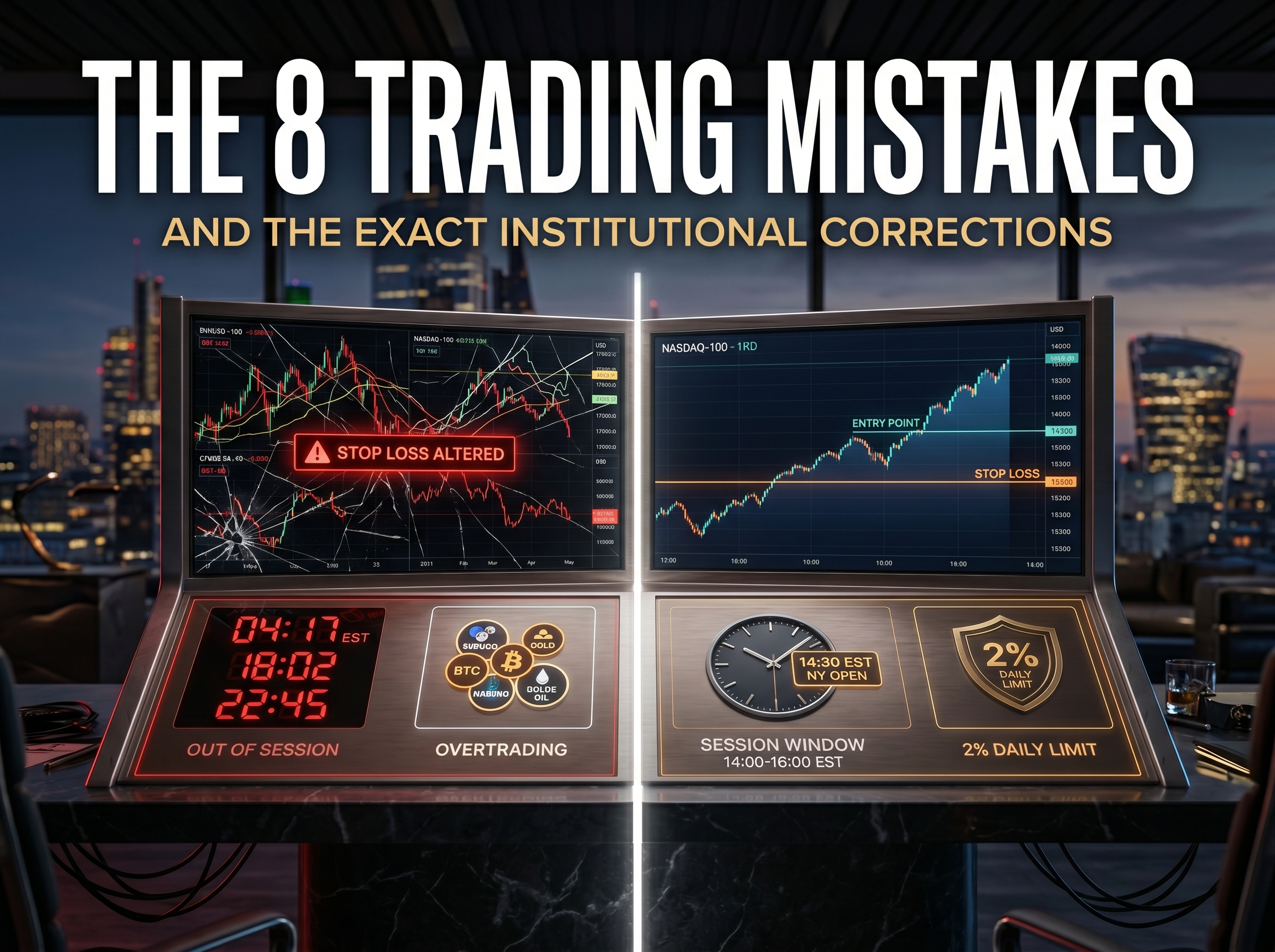
8 most expensive day trading mistakes for beginners — and the institutional corrections — .ONE% Capitals worldwide
The 8 Mistakes That Cost Day Traders the Most — and the Exact Institutional Corrections

Your Daily Routine: What a Professional Day Trading Session Looks Like

Professional day traders do not improvise. Every session follows a structured routine that was designed in advance to remove discretionary decisions at the worst possible moments. This is the exact daily schedule used by .ONE% intraday students worldwide.

Night Before (10 min)
Check economic calendar for tomorrow. Mark all red-impact events. Note the event time in your timezone. Decide in advance: trade as normal, reduce size by 50%, or avoid the session entirely if multiple red events cluster.
Pre-Session (15–20 min)
Daily and H4 bias assessment. Mark Asian session high/low. Mark key support and resistance levels. Mark liquidity pools. Write down the directional bias and the levels where setups are expected. Set alerts if needed. Platform ready.
Active Session (90–120 min)
Observe the session open for 5–10 min. Watch the liquidity sweep. Wait for 3-confluence setup. Execute with pre-defined parameters. Maximum 2–3 trades per session. If 2% daily stop hit — close platform immediately.
Post-Session (10–15 min)
Screenshot all trades. Log in journal: setup, entry trigger, confluences, rule adherence, outcome. Rate the session on process quality (1–10) — not P&L. Close platform. Session is complete.
Weekly Review (30 min Sunday)
Review the entire week's journal. Identify the single most common mistake. Focus on correcting only that one mistake in the coming week. Track win rate, average R:R achieved, and rule adherence rate across the week.
Monthly Assessment (1 hour)
Review 4 weeks of journal data. Are you consistently rule-compliant? Is the strategy producing positive expectancy over 20+ trades? If yes — begin prop firm evaluation planning. If no — identify the specific gaps and continue demo practice.

Day Trading with Prop Firms: The Funded Account Path

Day trading is the strategy most directly compatible with prop firm evaluations. FTMO's rules (5% daily drawdown, no overnight holding requirement, session-based trading) were essentially designed around the intraday framework. A day trader who follows the .ONE% rules automatically satisfies the vast majority of FTMO evaluation requirements.

Why Day Trading + FTMO is the Most Compatible Combination
FTMO's structure rewards exactly what a disciplined day trader does: consistent small gains, strict daily loss limits, no overnight exposure. A trader targeting 0.5–1% per day reaches the 10% Phase 1 target in 10–20 sessions. The 5% daily drawdown limit is protected by the personal 2% daily stop. The evaluation becomes a demonstration of the same habits built during preparation — not a new experience.
FTMO — Primary Recommendation Blueberry — Good First Option The5ers — Valid for Intraday Too
Start Day Trading the Right Way — .ONE% Programs
Entry Level
.ONE% Cartel
40 Days · Group · 1 Strategy
  • Market DNA & Intraday Structure
  • Session-Based Analysis Method
  • 1 Proven Intraday Strategy
  • Risk Management Module
  • Live Trading Sessions
  • Lifetime Trading Assistance
₹40,000
Per Person · Group Batch
Enroll in Cartel
Professional
.ONE% Apex
60 Days · Prop Firm Focus · 2 Strategies
  • Full Intraday Framework
  • 2 Advanced Strategies
  • FTMO Evaluation Coaching
  • Funded Account Pass Guidance
  • Psychology & Execution Module
  • Session-Specific Setup Training
₹60,000
Per Person · Prop Firm Track
Enroll in Apex
Elite
.ONE% Onyx
75 Days · 1:1 · 4 Strategies
  • 4 Institutional Strategies
  • Personal 1:1 Mentor Sessions
  • Live Trading With Mentors
  • FREE $10,000 Funded Account
  • 1 Month Community Access
₹1,25,000
Per Person · Includes Funded Account
Enroll in Onyx
Premium Elite
.ONE% Vantage
90 Days · Intensive · 5 Strategies
  • 5 Elite Institutional Strategies
  • Institutional Discipline Focus
  • Personal 1:1 Sessions
  • FREE $50,000 Funded Account
  • 3 Month Community Access
₹3,00,000
Per Person · Elite Mentorship
Enroll in Vantage
.ONE% Capitals intraday day trading mentorship — funded traders on FTMO worldwide — India UAE UK Singapore
.ONE% Day Trading Students — From First Session to FTMO Funded Accounts Worldwide
Two Focused Hours a Day. A Trading Career.
Stop Trading Without a System.
Start Trading With Institutional Logic.

The London open happens tomorrow. The New York open happens every evening. The setups are there — daily, reliably, predictably. What determines your outcome is whether you approach them with an institutional framework or without one. Book your free strategy call today.

Frequently Asked Questions
Day trading (intraday trading) is the practice of opening and closing all trading positions within a single session — typically within 2 to 4 hours. Day traders profit from intraday price movements, targeting 20 to 80+ pip moves in forex or 50 to 200 point moves in indices, with all positions closed before the session ends to avoid overnight risk.
For personal broker accounts, $500–$1,000 is the practical minimum for meaningful position sizing. The prop firm model eliminates this requirement — you pass an evaluation and trade the firm's capital. .ONE% Onyx and Vantage students receive free funded accounts of $10,000 and $50,000 as part of their program, allowing professional day trading without personal capital. There is no minimum for demo account practice — start there first.
Day trading is profitable for traders who apply consistent institutional risk management (1% max per trade, 2% daily stop), follow a tested strategy with positive expectancy, and maintain psychological discipline across a large sample of trades. The majority of day traders who lose money do so due to emotional trading and inadequate risk management — not because profitable intraday strategies don't exist. The .ONE% framework specifically addresses both failure modes.
The London session open (8:00 AM–10:30 AM GMT / 1:30 PM–4:00 PM IST) and the New York session open (1:00 PM–3:30 PM GMT / 6:30 PM–9:00 PM IST) are the two highest-quality windows for intraday trading globally. Both offer the highest liquidity, tightest spreads, and the most reliable institutional order flow patterns. Outside these two windows, the professional approach is to close the platform.
EUR/USD is universally recommended as the starting instrument for forex day traders — it has the tightest spreads (0.1–0.3 pips), the highest daily liquidity in the world, and the most predictable reaction to London and New York session opens. Gold (XAU/USD) is the premium intraday instrument for more experienced traders. For equity day traders, the Nasdaq CFD during the New York session provides excellent daily range and clean institutional structure.
The PDT rule (requiring $25,000 minimum balance to make more than 3 day trades in 5 days) applies exclusively to US equity markets trading through US-regulated brokers. It does NOT apply to forex trading, CFD trading, or traders using international brokers and prop firms. Day traders using FTMO, The5ers, Blueberry or international brokers can trade as frequently as their strategy requires with no capital minimum restrictions related to the PDT rule.
.ONE% teaches intraday trading across all four mentorship tiers, with the core day trading framework — session analysis, the liquidity sweep setup, the 3-confluence entry system, and the 5 non-negotiable rules — introduced in the Cartel (40 days) and built upon through Apex (60 days), Onyx (75 days) and Vantage (90 days). The Apex tier includes specific FTMO evaluation coaching for day traders. Onyx and Vantage students receive free funded accounts to deploy the intraday strategy immediately. Book a free call: calendly.com/pointone0/30min
KD
Keshav Dargar & Khushal Dudhoria
Co-Founders · .ONE% Capitals & Investments
Keshav and Khushal teach institutional day trading and swing trading frameworks to students worldwide — from beginner to funded professional. .ONE% Capitals has verified funded accounts on FTMO, The5ers and Blueberry. Serving traders across India, UAE, UK, Singapore and globally. India: +91 91166 52754 · UAE: +971 54 450 4401 · onepercent862@gmail.com · Book Free Call
Scroll to Top