

Ten years ago, trading for a living required either a finance degree and a job at an investment bank, or a personal trading account large enough to generate meaningful returns. The average person had neither. The barrier to entry was capital — and without capital, there was no career.
The prop firm model changed that completely. Today, a trader anywhere in the world can prove their skill in a structured evaluation, receive access to $10,000 to $200,000 in institutional capital, and keep up to 90% of the profits — without risking personal savings, without a degree, without connections, and without a suit.
This guide is the complete roadmap for that journey. It covers what funded trading actually is, what it realistically pays, the precise five-phase path from zero to funded, the mistakes that derail most people, and how .ONE% Capitals compresses the timeline through structured institutional training.
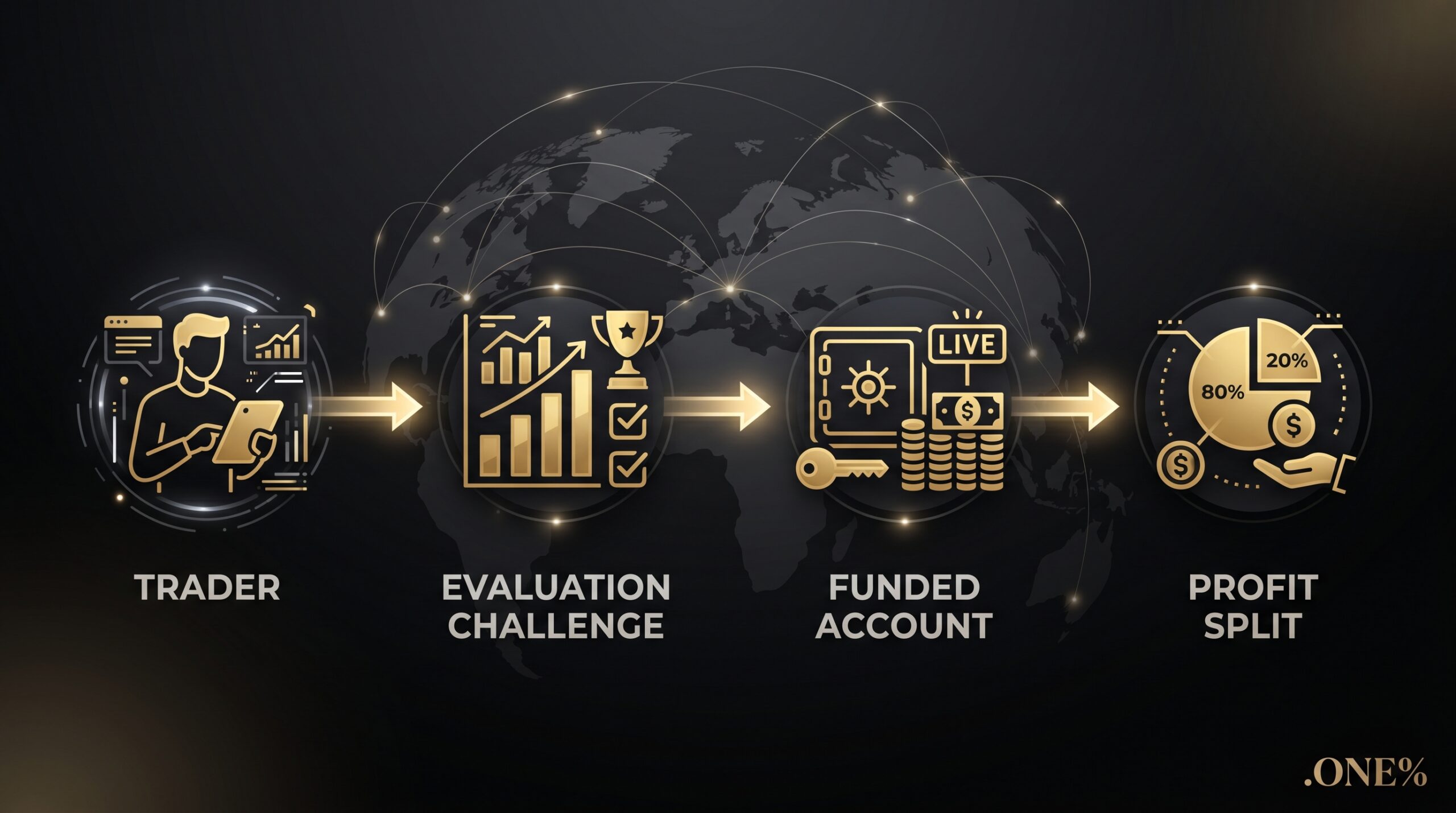
What Is a Funded Trader — and Is It a Real Career?
A funded trader is a trader who has passed a structured evaluation set by a proprietary trading firm and received access to that firm's capital to trade. The firm takes a percentage of profits (typically 10 to 20%) and the trader keeps the remainder. The trader operates no personal capital risk beyond the initial evaluation fee — which is itself refunded on the first profit split in most major firms.
The model is straightforward. The evaluation tests one specific thing: can this trader generate consistent positive returns while adhering to strict risk management rules? If yes, the firm allocates capital. If no, the evaluation fee is lost and the trader can attempt again.
Is it a real career? Yes — unambiguously. It is a career with no employer, no fixed hours, no geographic constraint, and income that scales directly with skill and consistency. Multiple .ONE% students trade funded accounts as their primary income. The honest qualifier is this: it is a career that requires genuine skill development, structured preparation, and a level of psychological discipline that most people underestimate until they attempt it.
"The prop firm model didn't lower the standard for success in trading. It lowered the capital barrier. The standard remains exactly what it always was: consistent, rule-governed, risk-managed execution."
How Much Can a Funded Trader Actually Earn?
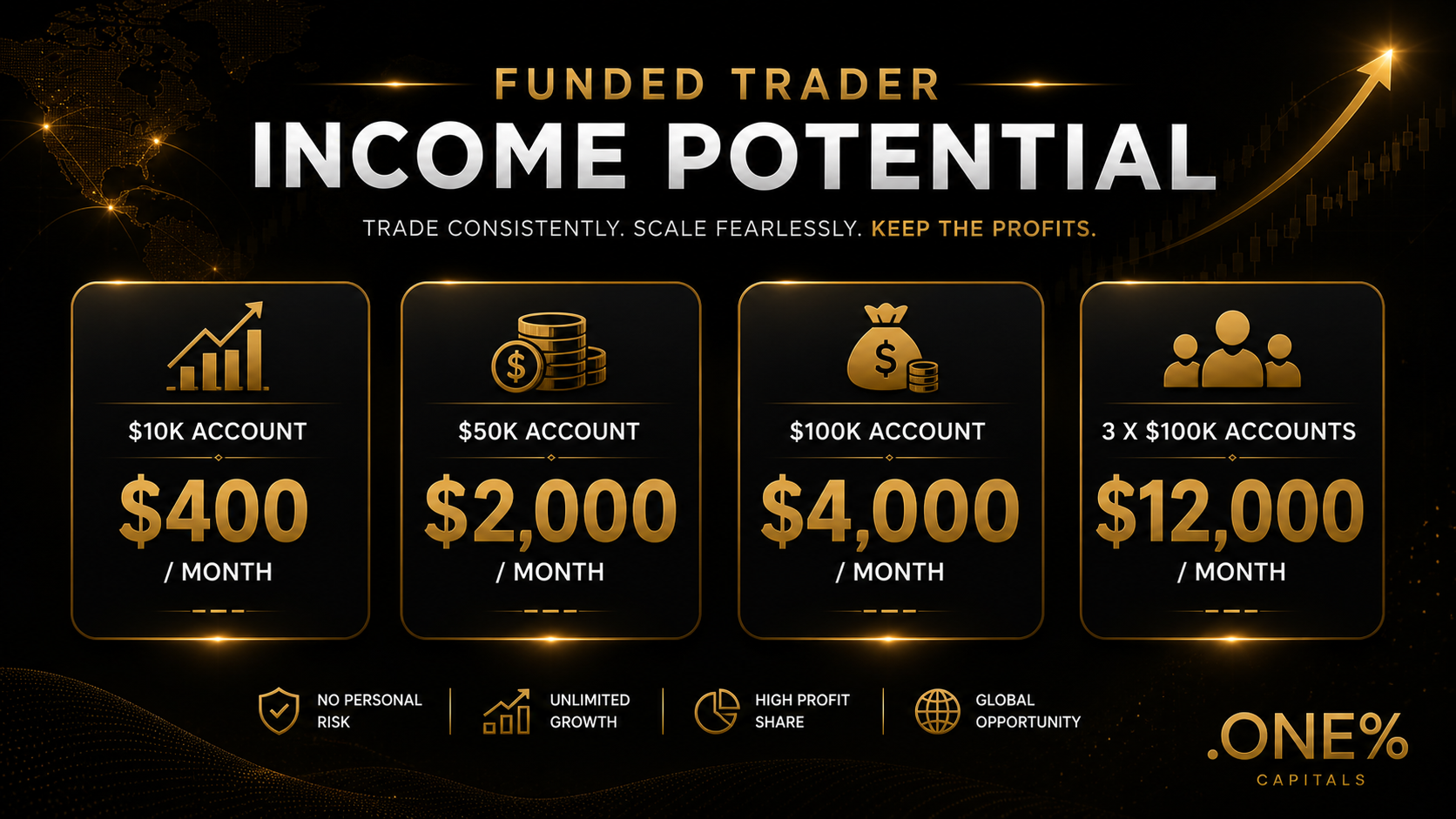
The income range for funded traders is genuinely wide — from a meaningful side income to a full institutional salary equivalent. What determines where you land on that range is not the prop firm you choose, but the account size you hold, the consistency of your monthly returns, and whether you scale to multiple funded accounts over time.
The calculation is straightforward. Here is a realistic income projection across different account sizes at a conservative 5% monthly return, with an 80% profit split:
The 5-Phase Zero-to-Funded Roadmap
This is the exact phase-by-phase path used in every .ONE% mentorship program. It is not a general outline — it is a specific, sequenced preparation system with realistic time estimates based on real student outcomes.
Before any strategy, chart pattern or indicator, you need to understand the structural mechanics of markets: who the participants are, how institutional order flow moves price, what creates support and resistance, and the mechanics of pips, lots, leverage and margin. Most self-taught traders skip this layer — and it costs them every time conditions shift.
- Market participants: institutions, banks, retail, HNIs
- Price structure: higher highs, lower lows, range identification
- Pips, lots, leverage, margin — full mechanical understanding
- Platform setup: MT4, MT5, or cTrader basics
- Choose your broker — demo account opened and configured
Technical and fundamental analysis studied in sequence, not isolation. This phase covers every tool you will actually use in live trading — chart patterns, indicators, support and resistance, economic calendars, and how macro data moves the instruments you trade. The goal is not to learn everything that exists — it is to deeply master the specific tools your strategy requires.
- Chart types: candlestick reading and pattern recognition
- Key indicators: MACD, RSI, Moving Averages, Bollinger Bands
- Support, resistance and liquidity pool identification
- Fundamental analysis: GDP, inflation, central bank policy impact
- Economic calendar mastery — trading around news events
A strategy is a repeatable, rule-based system with a defined edge over a large sample of trades. This phase covers developing a confluence-based entry framework, back-testing it across at least 100 historical setups, and then practicing it on a demo account under simulated prop firm conditions — 1% risk per trade, 2% daily stop, 0.5–1% daily target. No evaluation attempt before 30 profitable demo trading days.
- Strategy selection: scalping, intraday, swing or position
- 3-confluence entry requirement before every trade
- Back-testing: 100+ historical setups reviewed and logged
- Demo trading: minimum 30 sessions under prop firm rules
- Trade journal started — all sessions documented from day one
Only attempt the evaluation after 30+ consistent demo sessions under prop firm rules. Select your firm based on your strategy type and goals (FTMO for brand and scale, The5ers for flexibility and long-term growth, Blueberry for first-time confidence). Execute identically to demo — no strategy changes, no sizing changes. Target 0.5–1% per day. The evaluation is not a sprint. It is a demonstration of exactly what you practiced.
- Prop firm selected and evaluation fee paid
- Identical execution to demo — no deviations
- Phase 1 profit target reached — typically in 14–25 sessions
- Phase 2 verification completed — lower target, same rules
- Funded account agreement signed — capital allocated
The funded account is not the finish line — it is the starting line. This phase covers operating a funded account with the same discipline used during evaluation, requesting the first profit split (which refunds the evaluation fee), growing toward the scaling threshold, and eventually opening multiple funded accounts simultaneously to multiply income without increasing time investment.
- First profit split requested — evaluation fee refunded
- Scaling plan activated — account grows with performance
- Second funded account opened with different firm
- Monthly income established from profit splits
- Third account — multi-account strategy running in parallel
The Biggest Mistakes That Kill Funded Trader Aspirations
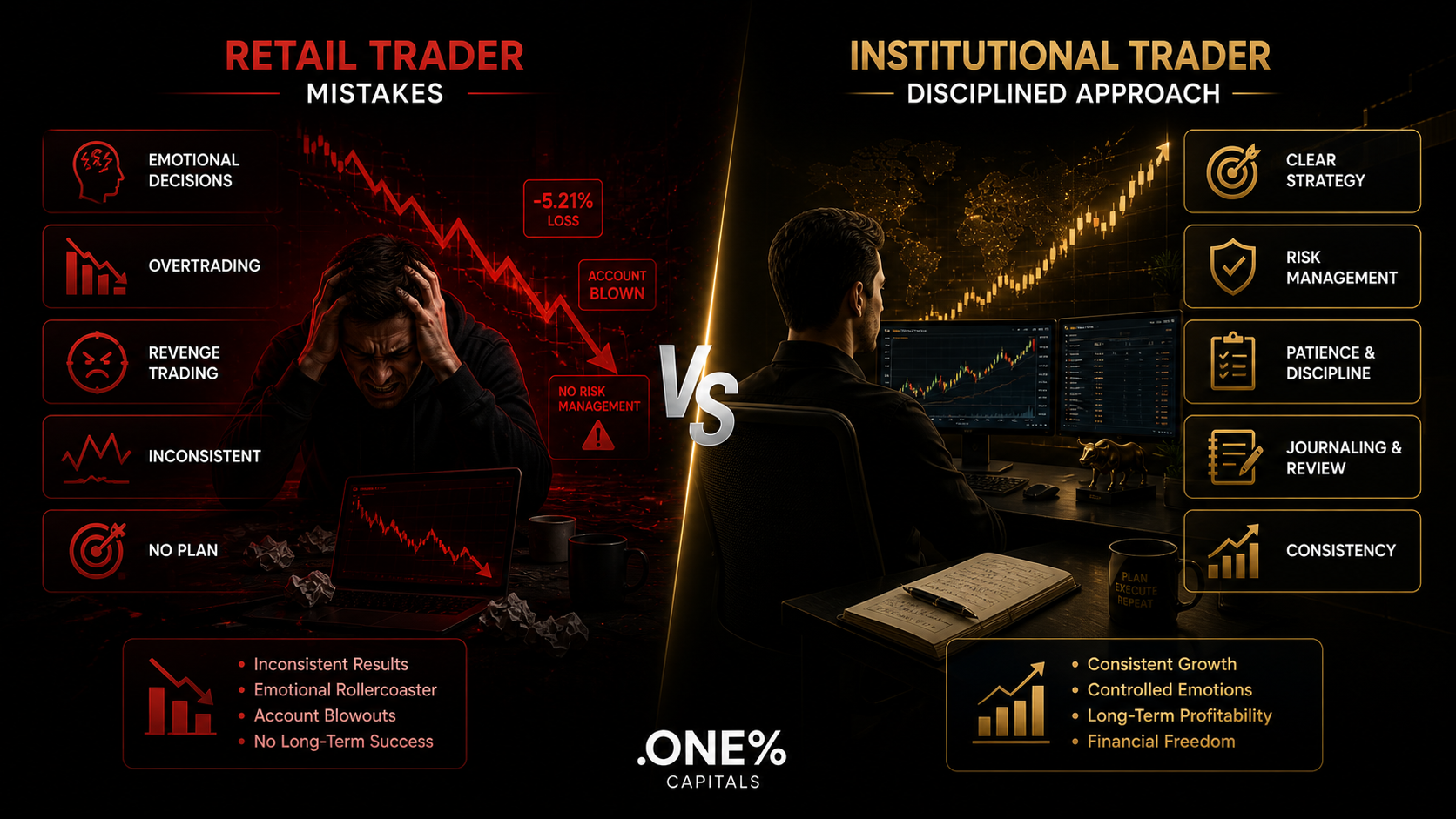
The failure rate at the evaluation stage is around 80%. The failure rate in the preparation phase is far higher — most people give up long before they ever attempt an evaluation. Here are the specific mistakes that cause both types of failure, and the exact corrections.
-
Attempting an Evaluation Without Structured PreparationThe most common and most expensive mistake. A trader watches YouTube videos for two weeks, opens an FTMO challenge, and blows it within three days. The evaluation fee is gone. The experience is demoralising. The trader either quits or repeats the same cycle. Structured preparation — minimum 30 demo sessions under prop firm rules before any live evaluation — eliminates this pattern entirely. The evaluation should feel like one more demo session, not a new experience.
-
Changing the Strategy During the EvaluationTraders who lose two trades in the first week of an evaluation often panic and switch to a different approach — or add indicators, change timeframes, or alter their entry criteria. This is fatal. The strategy has not failed — the sample size is too small to draw any conclusion. The evaluation is a test of consistency, not just profitability. Execute the exact same strategy used during preparation, regardless of early drawdown.
-
Treating the 10% Profit Target as a SprintThe FTMO challenge has a 30-day minimum period but no maximum. A trader targeting 3% per day to reach 10% quickly is gambling with a 5% daily drawdown limit. A single emotional session ends the challenge. The correct approach: target 0.5–1% per day, reach the profit target in 10–20 sessions, and spend the remainder of the evaluation period protecting the gains. Patience is the strategy.
-
No Trading Journal — No Feedback LoopWithout a journal, every mistake is made in isolation. There is no visibility into patterns: the tendency to revenge trade on Mondays, to oversize after a winning week, to exit early when news events are scheduled. A journal turns individual mistakes into identifiable patterns — and identifiable patterns are fixable. It takes five minutes per session. The traders who skip it are the ones who repeat the same mistakes across multiple failed evaluations.
-
Self-Teaching Without a Framework — The 12-Month TrapSelf-taught traders spend an average of 12 to 36 months reaching the point where structured mentorship students arrive in 40 to 90 days. This is not because self-teaching is impossible — it is because the internet provides unlimited information with no sequence, no quality filter, and no feedback. Without a structured curriculum, traders spend months learning approaches that conflict with each other, testing strategies without a proper back-testing process, and making avoidable mistakes with no one to correct them.
Choosing the Right Prop Firm for Your Stage
The prop firm you choose should match your current preparation level and your career objective — not just the one with the most followers on social media. Here is the honest framework for making this decision.
| Your Stage | Best Firm | Reason | Key Advantage |
|---|---|---|---|
| First-time evaluation attempt | Blueberry Funded | Lowest Phase 1 target (8%), fastest payouts, most forgiving rules | Confidence building |
| 40–60 days structured prep complete | FTMO | Gold standard brand, largest accounts, fee refund on first payout | Global recognition |
| Swing / news trader strategy | The5ers | Allows weekend holding and news trading, 1-phase evaluation | Rule flexibility |
| Building long-term capital base | The5ers | Built-in scaling plan to $4,000,000 based on performance alone | Capital growth |
| Ready to scale income | FTMO + The5ers + Blueberry | Multiple simultaneous funded accounts — same strategy, 3× income | Income multiplication |
| .ONE% Onyx student | Free $10K Account Included | Evaluation fee bypassed entirely — funded account provided in program | No evaluation cost |
| .ONE% Vantage student | Free $50K Account Included | $50,000 funded account included — skip evaluation completely | Immediate large account |
How Long Does It Actually Take?
This is the question every aspiring funded trader asks — and the answer varies enormously depending on one variable: structured preparation versus self-teaching.
The .ONE% Accelerated Path — What Structured Mentorship Actually Delivers
The .ONE% curriculum compresses the zero-to-funded timeline by doing three things that self-teaching cannot: providing a sequenced, quality-filtered curriculum, delivering real-time feedback on live trading sessions, and building psychological discipline habits through simulated prop firm conditions from the very first session.
Every tier covers the same six-module core: Market DNA, Technical Mastery, Strategy Deployment, Psychology and Discipline, Live Market Execution, and Funding and Growth. What scales between tiers is the depth of the strategies, the duration of live practice, whether you receive 1:1 mentorship, and whether a funded account is included.
- Complete Market DNA Curriculum
- 1 Proven Institutional Strategy
- Psychology & Discipline Module
- Live Trading Sessions
- Lifetime Trading Assistance
- Multi-Asset & Multi-Market
- Full Curriculum + 2 Strategies
- Prop Firm Evaluation Coaching
- FTMO Challenge Preparation
- Funded Account Pass Guidance
- Execution Under Pressure Training
- Multi-Commodity Strategy
- 4 Institutional Strategies
- Personal 1:1 Mentor Sessions
- Live Trading With Mentors
- FREE $10,000 Funded Account
- 1 Month Community Access
- 5 Elite Institutional Strategies
- Institutional Discipline Intensive
- Personal 1:1 Sessions
- FREE $50,000 Funded Account
- 3 Month Community Access

Unstructured Self-Teaching.
The difference between 12 months of solo struggle and 60 days to a funded account is a structured curriculum, live feedback, and a mentor who has already done it. Book your free strategy call — we will assess your current level and map the exact path to your first funded account.